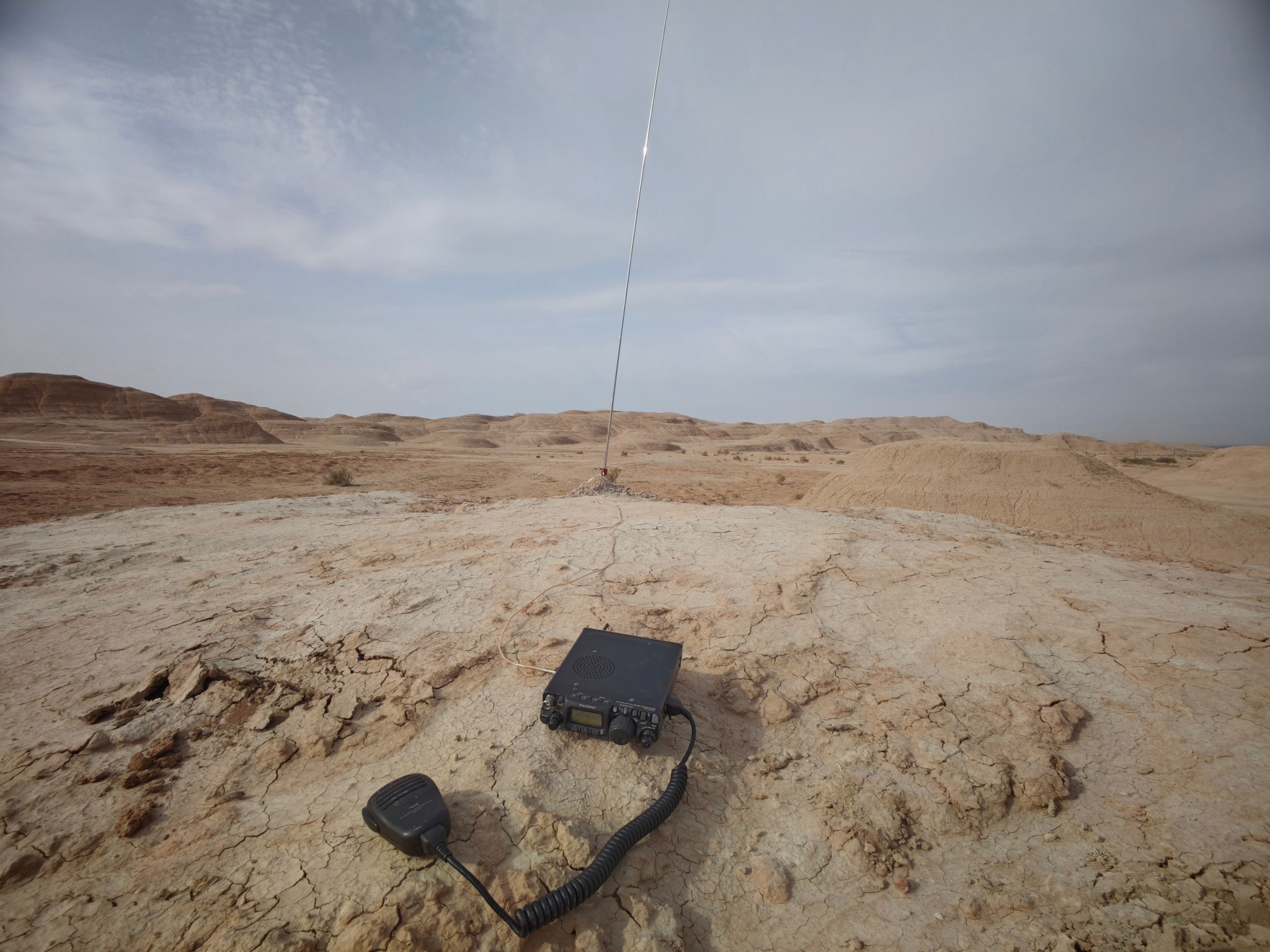
The radio, hand microphone, and antenna out among the yardangs. The antenna is standing in the photo, but it fell over several times during the attempt.
I took my QRP setup out to a yardang landscape in Xinjiang and came back with a slightly embarrassing field story. The location was wide open, the noise floor sounded low, and the SWR looked good. I still didn’t complete a single contact.
My GP vertical kept falling over.
Plenty of space, nowhere to push the antenna in
There was plenty of room for the station. The open landscape was exactly what the photographs show. The difficulty was underfoot: the ground was very hard, with rock beneath it, and I couldn’t push the GP antenna into it.
That left a fairly basic part of the setup unresolved. I had space to lay out the equipment and put up the antenna, but I didn’t have a reliable way to keep the antenna upright.
The rocks helped, briefly
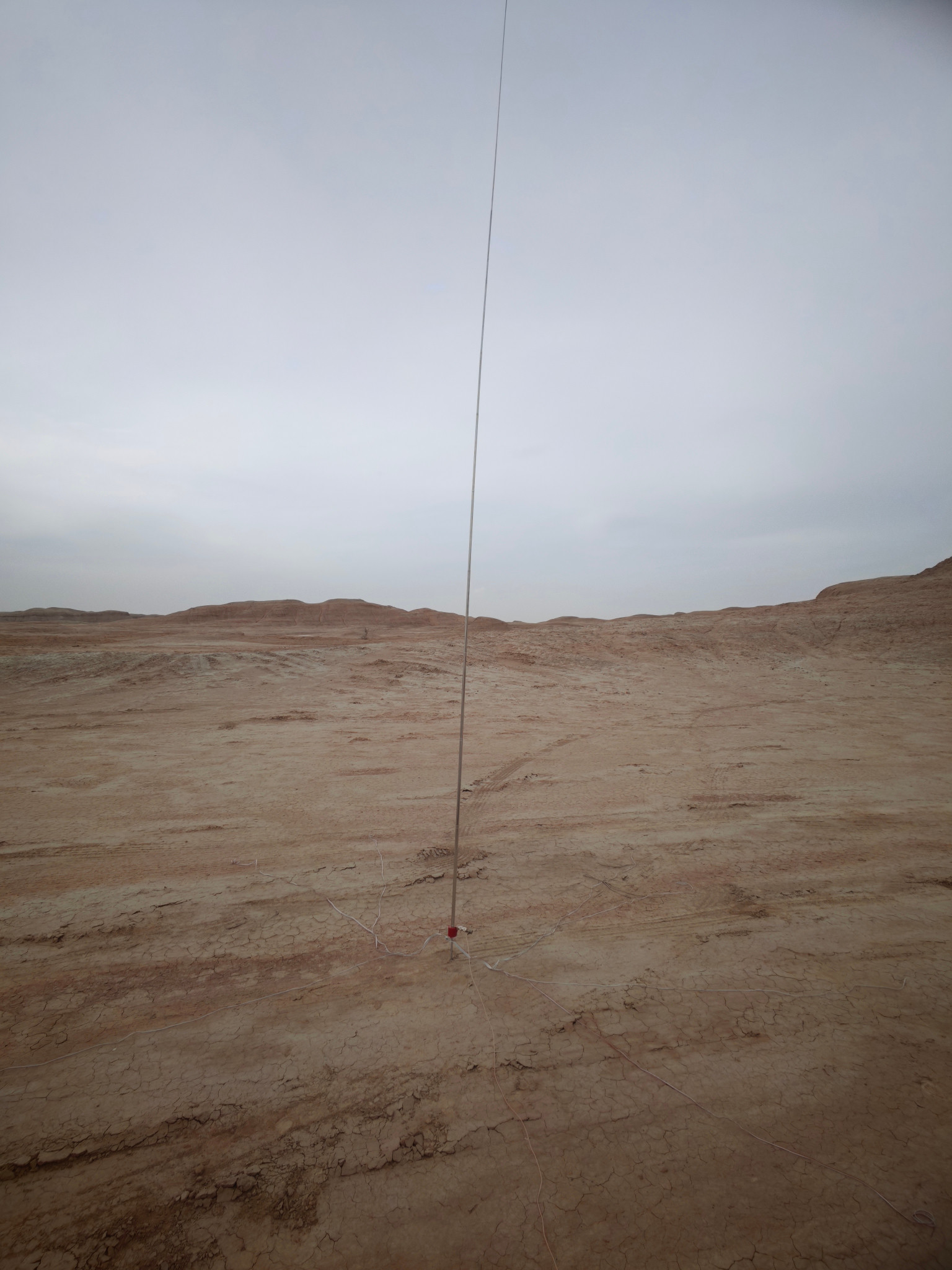
I tried weighing down the base with rocks. That got the antenna standing for a while, but it didn’t stay that way for long. It fell over again.
This happened several times. Putting it back up didn’t produce a lasting fix, and the rocks around the base never gave it enough stability to support even one completed contact.
The photos capture the more respectable-looking part of the outing: a radio on the ground, a vertical antenna, and a wide-open landscape behind it. They don’t convey how temporary that upright antenna was.
“Have you caught any fish here?”
There was another unexpected moment during the outing. An older man arrived in a small, low-speed electric vehicle. I was surprised to see him there, and I suspect he was surprised to see me too.
We looked at each other for quite a while. I was worried that he might be a worker from the oil operations in the area, about to tell me I had to leave. I didn’t know who he was; that was just what was going through my mind.
Eventually, he spoke.
“Have you caught any fish here?”
I laughed and said, “Yes, I’m here to fish.”
Low noise and good SWR
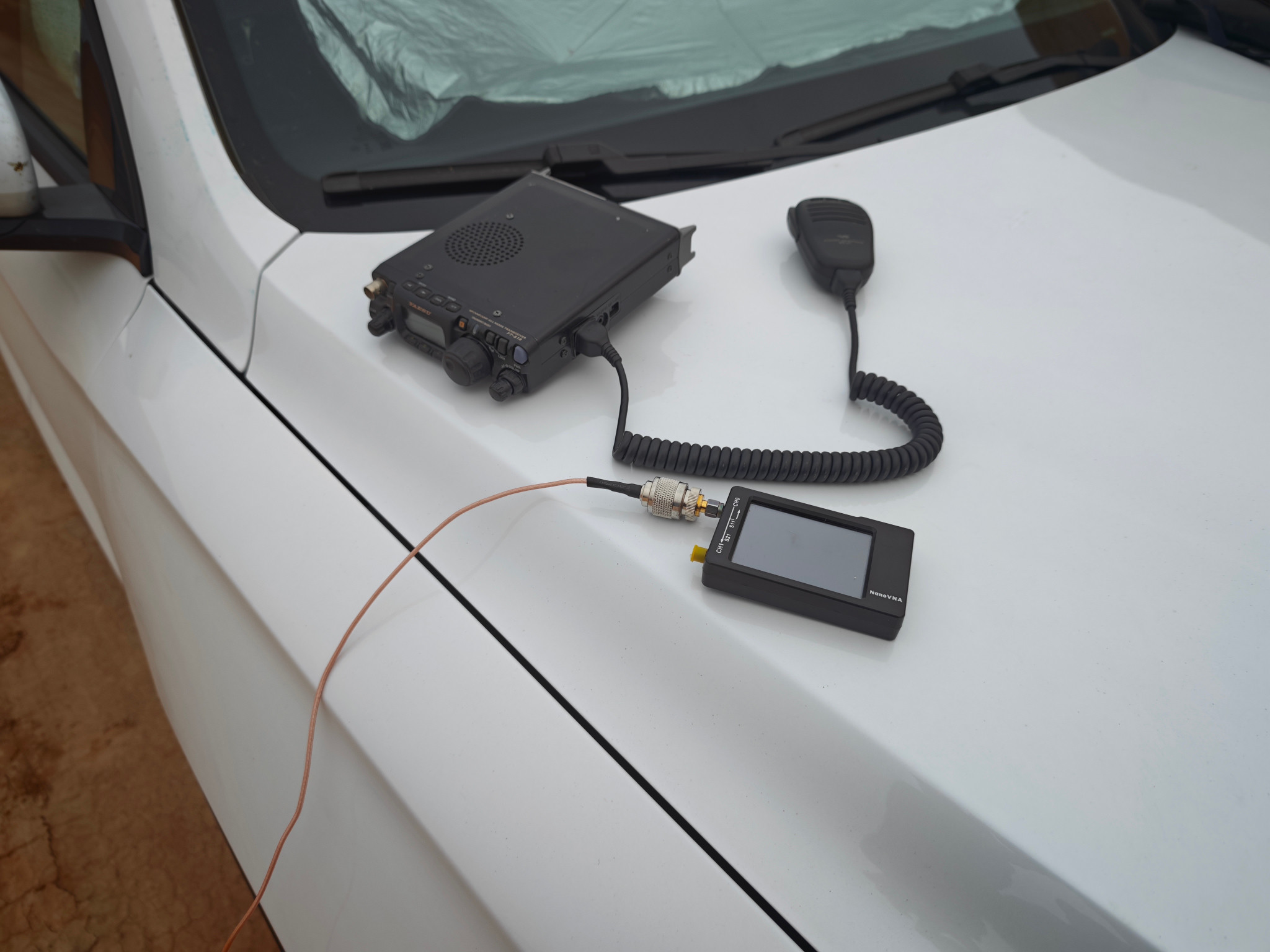
The frustrating detail is that the conditions I could check were encouraging. The noise floor sounded low, and the SWR looked good. Those observations are worth keeping in the story, even though the outing ended without a contact.
Neither observation solved the support problem. I still needed an antenna that would remain in place while I operated. With it repeatedly falling over, the station never became stable enough to complete a QSO.
So there’s no successful contact to report from this attempt, and no distance record to attach to the photos. What I can report is straightforward: an open location, low audible background noise, good SWR, and an antenna mounting arrangement that let me down.
Would B0 at the front attract more attention?
I mainly used B0/BA7MTH, occasionally switching to BA7MTH/0. That got me thinking: for QRP, hearing B0 first might make someone notice call area 0 sooner and perhaps take more interest in a contact. Area 0 includes both Xinjiang and Tibet, so I would still need to state the location to make Xinjiang clear.
On the other hand, someone accustomed to a suffix might find B0 at the front momentarily confusing. How do I balance an earlier location clue against a form the listener finds familiar? I didn’t complete a QSO on this outing, so I can’t claim any evidence of an advantage. It is a question for discussion.
Rules note: the prefix format has a basis in China’s former rules, but those rules were replaced in 2024; that older provision should not be presented as a current mandate. There is also no universal international suffix format.
First, make it stay up
The practical lesson is a small one that comes before any contact report: check how the antenna will be supported on the ground that is actually there.
For another outing on hard ground, a portable base, a suitable tripod, or an appropriate guying arrangement would be options to consider. Any of those would need testing on this kind of ground. Simply adding rocks around the base was not enough on this occasion.
The order of preparation matters here. Put the antenna up, establish that it can remain securely in place, then continue with the electrical checks and operating. A good SWR reading belongs in that process, alongside a mounting arrangement that lasts.
This time, the SWR passed. My antenna’s ability to stay standing still needs some work.