If you are learning CW, setting up a radio menu, researching electronic keys, or comparing different amateur radio callsigns, you will probably come across the term CW Weight.
At first it can be confusing, because "weight" here does not mean physical mass. In amateur radio, CW weight usually refers to one of two different things:
The time a callsign takes to send in Morse code, often called callsign weight.
A setting in a radio or electronic keyer that adjusts the timing ratio between dots and dashes.
Both ideas are related to Morse code timing, but they describe very different things.
What does CW mean?
CW stands for Continuous Wave.
In amateur radio, CW normally means communication using Morse code. A Morse character is built from:
Dits, also called dots
Dahs, also called dashes
The space between elements inside a character
The space between characters
The space between words
Because different letters contain different numbers of dots and dashes, some characters take much longer to send than others. That difference is the root of the first meaning of CW weight.
Meaning 1: Callsign CW weight
When hams talk about the CW weight of a callsign, they usually mean:
The time, or number of Morse timing units, needed to send the full callsign once.
For example:
E = .
T = -
J = .---
Q = --.-
The letter E is extremely quick to send. The letter J takes much longer. So two callsigns with the same number of characters can have very different CW weights.
This idea is also called:
Callsign weight
CW callsign weight
Morse code weight
Why callsign weight matters
For casual operation it usually does not matter very much. But for operators who spend a lot of time on CW, a lighter callsign can have real advantages.
Faster transmission. A lighter callsign takes less time to send. The difference may be tiny during one QSO, but after hundreds or thousands of contacts in a contest the time savings add up.
Easier recognition. Some Morse combinations have a clear, distinctive rhythm. A good CW callsign is not necessarily just short; it can also have a rhythm that is easy for other operators to recognize.
Easier manual sending. If you use a straight key, paddle, bug, or sideswiper, some callsigns simply feel more comfortable to send. That feel is partly subjective, but Morse timing plays an important role.
Is a short callsign always lighter?
No. Character count and CW weight are not the same thing.
Relatively short characters include:
E.
I..
T-
A.-
N-.
Longer characters include:
J.---
Q--.-
Y-.--
0-----
So a five-character callsign can sometimes be quicker to send than a four-character callsign, depending on the letters and numbers involved. That is one reason CW enthusiasts study callsign weight when choosing a vanity callsign.
Meaning 2: CW weight in an electronic keyer
The second common meaning of CW weight appears in transceiver and electronic keyer menus.
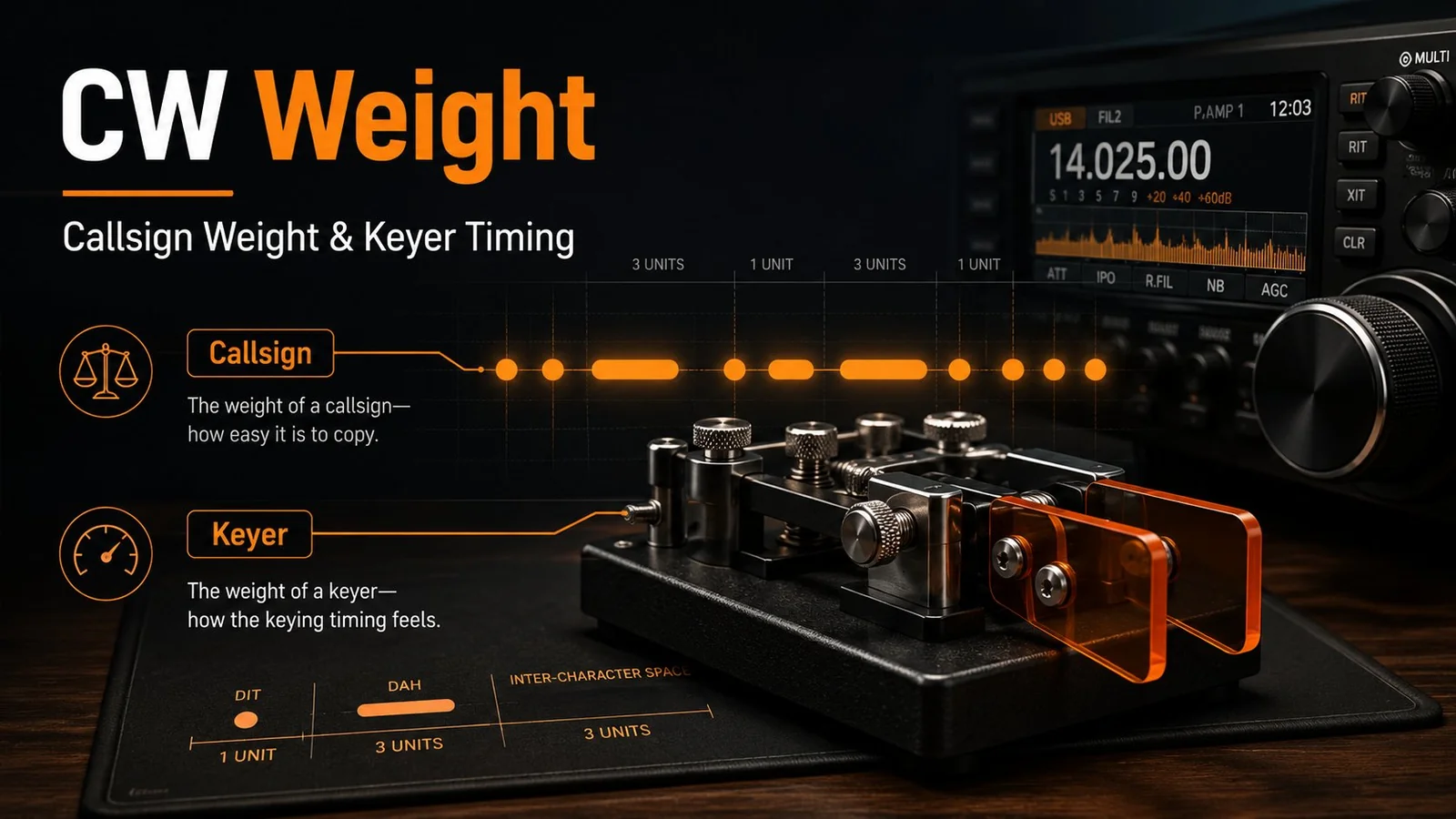
In this case, CW weight describes the relative duration of the key-down and key-up portions of Morse elements.
In standard Morse timing:
A dit is one time unit.
A dah is three time units.
The space between elements of the same character is one time unit.
An electronic keyer normally generates these timings automatically. A weight setting changes the relationship slightly.
What happens when you change keyer weight?
Increasing the weight generally makes the transmitted dits and dahs sound slightly heavier or more "filled in." Decreasing the weight makes them sound lighter or more open.
The exact behavior depends on the radio or keyer manufacturer. If your radio manual includes a CW weight setting, check the manufacturer's explanation for the specific range and effect.
Why adjust keyer weight?
Most operators can leave the setting at its default. But CW weight adjustment can be useful for:
Matching a personal sending preference
Matching the feel of a particular keyer
Changing the perceived rhythm of the transmitted CW
Compensating for timing characteristics in external equipment
Reproducing a particular CW sending style
Very large changes are usually unnecessary. Good Morse code depends more on stable, clear timing than on unusual weighting.
CW weight is not the same as CW speed
This is a common point of confusion.
CW speed is normally measured in words per minute, or WPM. For example:
10 WPM
15 WPM
20 WPM
25 WPM
Increasing CW speed makes the entire Morse transmission faster.
CW weight does not simply change speed. If we are talking about callsign weight, it describes how long a particular callsign takes to send because of its character composition. If we are talking about keyer weight, it describes the timing balance of the generated Morse elements.
How callsign weight is calculated
A callsign weight calculator assigns timing units to each Morse element and adds them up. The most common base rules are:
Dit = 1 unit
Dah = 3 units
Space between elements of the same character = 1 unit
Space between characters = 3 units
Using those rules, two callsigns can be compared directly. For someone choosing a vanity callsign, this can be surprisingly useful: a callsign that looks shorter on paper is not always shorter on the air.
Does CW weight matter for beginners?
If you are learning Morse code, CW weight should not be a major concern yet. Focus first on:
Recognizing characters by sound
Maintaining correct rhythm
Sending clean dits and dahs
Building comfortable copy speed
Developing your CW ear
Once you become more experienced, you will naturally begin to notice that some callsigns, abbreviations, and words have very different Morse rhythms. That is when CW weight becomes intuitive.
Practice with CW599 tools
If you want to train your ear for callsign rhythm, the CW599 Callsign Trainer lets you listen to random callsigns at a speed you choose. If you are still building character recognition, the CW599 Letter Trainer focuses on single letters and helps you reach a stable copy speed before moving to callsigns and words.
Final thoughts
The phrase CW weight has two different meanings in amateur radio.
When talking about callsigns, it describes how long or "heavy" a callsign is when transmitted in Morse code. When talking about a radio or electronic keyer setting, it describes the timing balance of Morse elements.
Understanding the difference helps avoid confusion when reading radio manuals, comparing callsigns, or configuring a CW keyer. And if you enjoy CW operation, calculating the weight of your own callsign is a fun way to look at Morse code from a completely different perspective.
Turn on an HF transceiver, switch the mode to CW, and start tuning the VFO.
Then comes a simple question:
Where should you tune?
For operators who are just beginning to make real CW contacts, this is an easy question to overlook.
We know that the 20-meter amateur band is around 14 MHz and 40 meters is around 7 MHz, but each amateur band can be tens or even hundreds of kilohertz wide. If you simply scan the entire band at random, you may spend a long time tuning without hearing much CW activity.
After decades of amateur radio operation, however, fairly stable CW operating habits have developed around the world.
Some parts of a band are where you are more likely to hear ordinary CW QSOs. Some frequencies are recognized as activity centers for low-power QRP operators. Others are commonly associated with slower-speed QRS activity.
Understanding these patterns is far more useful than simply memorizing that “7 MHz is the 40-meter band.”
First: There Is No Single Worldwide “CW Calling Frequency”
This is important.
Amateur radio CW does not work like maritime VHF, where there is a globally recognized calling and distress channel such as Channel 16.
CW activity normally occupies a range of frequencies, rather than a single channel where everyone gathers.
The International Amateur Radio Union, or IARU, divides the world into three major regions:
Region 1: mainly Europe, Africa, the Middle East, and parts of Russia;
Region 2: mainly North America, South America, and the Caribbean;
Region 3: mainly China, Japan, Korea, India, Southeast Asia, Australia, New Zealand, and the Pacific.
The band plans in these three regions are broadly similar, but they are not identical.
For example, the current IARU Region 3 Band Plan identifies 7000–7030 kHz as a CW segment on 40 meters, while 7030 kHz is also listed as a QRP Centre of Activity.
Region 1 and Region 2 arrange parts of 40 meters somewhat differently, and operators in the United States are also subject to FCC license-class privileges and frequency limits. ARRL also emphasizes that a band plan is primarily a voluntary coordination tool and is not the same thing as legal frequency authorization.
So the better question is:
“Which frequencies are the best places to look for CW operators?”
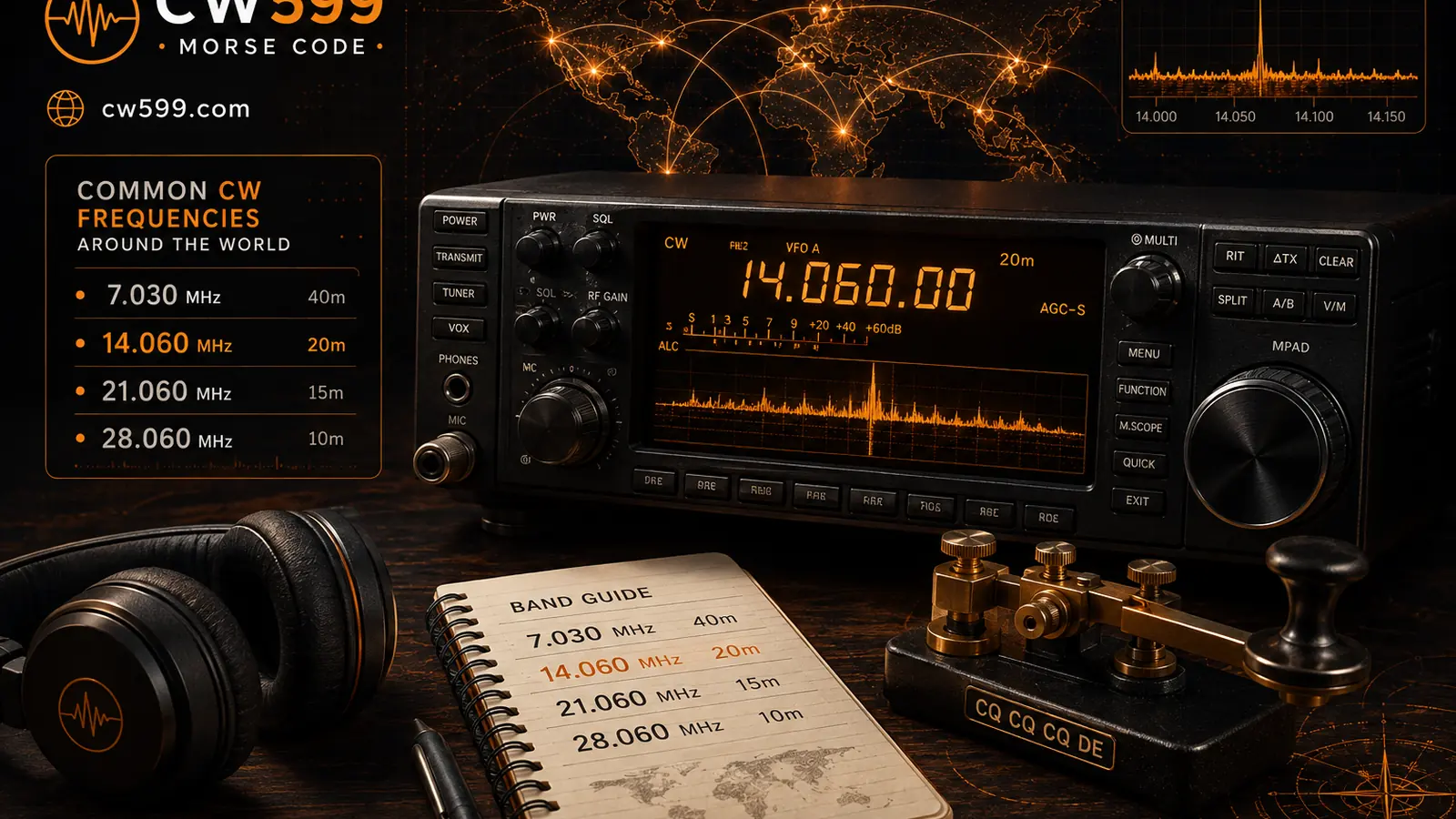
A Quick Reference to Major CW Frequencies
The following table is intended as a practical operating reference.
Band
Common CW Activity Area
Frequencies Worth Remembering
Typical Use
160 m
Around 1.800–1.840 MHz
1.836 MHz
QRP / CW activity center
80 m
Around 3.500–3.600 MHz
3.560 MHz
CW QRP
40 m
Around 7.000–7.040 MHz
7.030 MHz
Major worldwide CW QRP activity center
30 m
Around 10.100–10.130 MHz
10.116 MHz
CW QRP
20 m
14.000–14.070 MHz
14.055 / 14.060 MHz
QRS / QRP
17 m
18.068–18.095 MHz
18.086 MHz
CW QRP
15 m
21.000–21.070 MHz
21.055 / 21.060 MHz
QRS / QRP
12 m
24.890–24.915 MHz
24.906 MHz
CW QRP
10 m
28.000–28.070 MHz
28.055 / 28.060 MHz
QRS / common CW QRP activity
An “activity center” does not mean that every contact must take place on exactly that frequency.
For example:
14.060 MHz is a QRP Centre of Activity.
What that really means is:
“If you are operating low-power CW, or you want to find QRP stations, this is a good place to start listening.”
It does not mean:
“All CW QSOs should take place on 14.060 MHz.”
Those are two very different ideas.
Common CW activity centers are a starting map, not a list of guaranteed clear frequencies.
160 Meters: 1.8 MHz — The Nighttime CW World
160 meters is often called the Top Band.
It depends heavily on nighttime propagation, and the antennas required can be physically large. For that reason, it is not as easy to enter as 40 or 20 meters.
But for operators who enjoy low-band DX, 160 meters has a unique appeal.
In the current IARU Region 3 Band Plan:
1800–1830 kHz: CW
1830–1840 kHz: CW + narrowband
and:
1836 kHz
is listed as a QRP Centre of Activity.
This band also demonstrates why worldwide frequency habits are not always identical.
For example, the ARRL Band Plan in the United States identifies:
1810 kHz
for CW QRP activity.
So on 160 meters, it is not safe to assume that every part of the world uses exactly the same QRP activity center.
For intercontinental DX, the best practice is to check the band plans and regulations that apply to both ends of the contact.
80 Meters: 3.5 MHz — A Very Active Nighttime CW Band
80 meters is another classic nighttime band.
It is especially useful for regional communication.
During the evening in Asia, Europe, or North America, it is common to hear significant CW activity near the lower end of the band.
The current IARU Region 3 plan includes:
3500–3510 kHz: CW, DX
3510–3535 kHz: CW
Above that, CW increasingly shares spectrum with other narrowband modes and, later, voice operation.
One frequency worth remembering is:
3560 kHz
which is listed as a CW QRP Centre of Activity.
So if you turn on 80 meters at night and do not know where to begin, start near:
3.500 MHz
and slowly tune upward.
If you are specifically looking for QRP stations, listen around:
3.560 MHz.
40 Meters: 7 MHz — Perhaps the Most Useful CW Band to Remember
If someone could choose only one band to begin practical CW operation, 40 meters would be one of the strongest candidates.
The reasons are simple:
it works during the day;
it also works at night;
regional coverage is excellent;
DX is possible when conditions cooperate;
worldwide CW activity is very high.
The current IARU Region 3 Band Plan identifies:
7000–7030 kHz
as CW.
The next segment:
7030–7040 kHz
allows CW together with other narrowband operation.
And:
7030 kHz
is designated as a QRP Centre of Activity.
This is a frequency worth remembering.
IARU Region 3 discussions of 40-meter planning have also described 7030 kHz as an important core CW frequency and a major worldwide QRP activity center.
For that reason:
7.030 MHz is probably one of the most useful CW numbers for a beginner to remember.
But that does not mean you should sit exactly on 7030 and call CQ continuously.
A better operating habit is:
listen around 7030 for activity;
move slightly up or down if the frequency is busy;
find a clear spot;
send QRL? to check whether the frequency is in use;
then begin calling CQ.
30 Meters: 10 MHz — A Band Made for CW
30 meters is a special band.
It is one of the WARC bands and is not normally used for the major traditional contests that can fill 20 and 40 meters.
That often makes it relatively quiet.
For operators who simply enjoy normal QSOs, DX, QRP, and unhurried CW, that is a major advantage.
IARU Region 3 recommends CW activity in:
10110–10130 kHz
with:
10116 kHz
listed as a CW QRP Centre of Activity.
There are some regional differences near the bottom of the 10 MHz allocation, so in practical operation it is useful to think of:
10.100–10.130 MHz
as a general CW-rich area worth scanning, while still following your local rules.
Another major feature of 30 meters is that in many countries the band is used mainly for CW and narrowband digital modes rather than ordinary voice communication.
From a CW operator's point of view, 30 meters can therefore feel like one of the purest HF bands.
20 Meters: 14 MHz — The Classic Global CW DX Band
If 40 meters is the practical all-rounder, then:
20 meters is the classic worldwide DX band.
Propagation around 14 MHz is extremely useful for intercontinental communication.
Open 20 meters during the daytime and you may hear callsigns from:
JA, VK, W, K, VE, DL, F, G, I, EA…
along with all kinds of DXCC prefixes.
IARU Region 3 identifies:
14.000–14.070 MHz
as the principal CW segment.
Two frequencies are especially useful to remember.
14.055 MHz — QRS Centre of Activity
In CW, QRS means:
Send more slowly.
For that reason, the area around 14.055 MHz can be a good place to find slower-speed CW activity.
The second frequency is even more famous:
14.060 MHz — CW QRP Centre of Activity
This is one of the best-known frequencies among QRP CW operators worldwide.
The IARU Region 1 band planning tradition also recognizes:
14.060 MHz
as a CW QRP activity center.
So if one day you take a 5-watt QRP radio and a portable antenna to a mountaintop:
listen around 14.060 MHz first.
It is rarely a bad place to start.
17 Meters: 18 MHz — An Underrated DX Band
17 meters is another WARC band.
It is usually less crowded than 20 meters and is not filled by traditional major contests.
IARU Region 3 identifies:
18.068–18.095 MHz
as the main CW segment.
Within that range:
18.086 MHz
is a CW QRP Centre of Activity.
17 meters is an interesting compromise.
When propagation is good, it offers some of the long-distance capabilities of 20 meters while usually having less atmospheric noise than the lower HF bands.
For operators who enjoy relatively quiet CW DX, it is well worth checking regularly.
15 Meters: 21 MHz — A Band That Suddenly Comes Alive
15 meters depends strongly on ionospheric conditions.
When propagation is poor:
the band may sound completely empty.
But when it opens:
CW stations thousands or even tens of thousands of kilometers away can suddenly appear one after another.
The IARU Region 3 CW plan is straightforward:
21.000–21.070 MHz: CW
with:
21.055 MHz — QRS Centre of Activity
and:
21.060 MHz — QRP Centre of Activity
These are easy to remember because they resemble the 20-meter pattern.
20 meters:
14.055 QRS
14.060 QRP
15 meters:
21.055 QRS
21.060 QRP
So a beginner does not actually need to memorize a huge number of frequencies.
12 Meters: 24 MHz — Another Quiet WARC CW Band
Like 17 and 30 meters, 12 meters is a WARC band.
Large traditional contests generally do not take over the band.
The main CW segment is:
24.890–24.915 MHz
and:
24.906 MHz
is a CW QRP Centre of Activity.
12 meters does not open every day.
But during strong solar conditions, it can support excellent long-distance propagation.
Experienced CW operators therefore do not always stay on 20 meters.
Checking 17, 15, 12, or even 10 meters from time to time can produce unexpected DX.
10 Meters: 28 MHz — One of the Most Magical Bands When It Opens
10 meters can be an extreme band.
When it is closed:
you may hear almost nothing.
When it opens:
5 watts, or even less, can sometimes work across continents.
The current IARU Region 3 plan identifies:
28.000–28.070 MHz
as a CW segment and designates:
28.055 MHz
as a QRS Centre of Activity.
In IARU Region 1 planning, another long-established frequency is:
28.060 MHz
as a CW QRP Centre of Activity.
So in real-world international CW operation:
28.055–28.060 MHz
is an especially useful area to scan.
It is worth noting that the latest Region 3 and Region 1 plans do not label every 10-meter activity center in exactly the same way. This is another reason to follow the band plan and regulations that apply where you are operating.
Where Are Ordinary CW Stations Actually Located?
There is another common misunderstanding.
Seeing:
14.060 = QRP
does not mean that ordinary 20-meter CW stations all operate on 14.060.
In real operation, you may hear CW QSOs on frequencies such as:
Stations can be spread throughout the CW portion of the band.
During major CW contests such as CQ WW CW, ARRL DX CW, or CQ WPX CW, activity can become extremely dense across nearly the entire usable CW segment.
A better way to remember the spectrum is therefore:
Remember the CW segment first, then remember a few important activity centers.
For example:
20 meters → 14.000–14.070 MHz
Then remember:
14.055 QRS
14.060 QRP
That is usually enough.
Why Is CW Usually Near the Bottom of an Amateur Band?
Look at almost every HF amateur band and you will notice an interesting pattern:
CW tends to occupy the lower-frequency end.
For example:
40 m: CW begins near 7.000 MHz
20 m: CW begins near 14.000 MHz
15 m: CW begins near 21.000 MHz
10 m: CW begins near 28.000 MHz
This is not an accident.
CW uses very little bandwidth.
A typical CW signal may occupy only a few hundred hertz, while an SSB signal commonly requires roughly 2.4–2.7 kHz.
Placing large numbers of narrow CW signals near the bottom of an amateur band is therefore an efficient way to organize spectrum.
In the current IARU Region 3 Band Plan, CW-priority segments commonly use a recommended maximum bandwidth of around 200 Hz, while wider voice segments may allow around 2700 Hz.
What Does “QRP Centre of Activity” Really Mean?
Consider:
7030 kHz — QRP CoA
CoA means:
Centre of Activity.
It does not mean:
a channel.
It does not mean:
an exclusive frequency.
And it does not mean:
“only QRP stations may operate here.”
It is better understood as:
“This area is commonly used by a particular type of operation, so give those stations reasonable consideration.”
If you hear a very weak S1 CW signal near 7030, do not immediately transmit over it with a CQ call.
It might be a station running:
5 watts, 2 watts, 500 milliwatts, or even only a few tens of milliwatts,
trying to complete a contact over thousands of kilometers.
QRS Frequencies Are Especially Useful for New CW Operators
CW also has a valuable tradition:
QRS
which means:
Send more slowly.
Some bands have recognized QRS activity centers.
Examples include:
14.055 MHz
21.055 MHz
28.055 MHz
These areas are particularly worth monitoring if you are just starting to make real CW contacts.
If you can comfortably copy only:
8 WPM, 10 WPM, or 12 WPM,
there is no reason to think you are “not ready.”
Look for operators at similar speeds around QRS activity areas.
CW is not a speed contest.
A QSO in which both operators copy each other correctly is more valuable than forcing the speed to 30 WPM before you are ready.
Why Do the Three IARU Regions Differ?
Because radio regulations are ultimately written by individual countries.
The 40-meter band is a good example.
The exact amateur allocation is not identical worldwide.
The United States has a 40-meter amateur allocation extending to 7.300 MHz, while in many Region 1 and Region 3 countries the amateur allocation normally ends at 7.200 MHz.
License classes can also restrict which parts of a band an operator may use.
The key principle is therefore:
The IARU Band Plan is an important guide to international operating practice, but national regulations always come first.
IARU Region 3 likewise makes it clear that where a regional band plan conflicts with national rules, the national regulations take precedence.
If I Am a CW Beginner, Which Frequencies Should I Remember First?
You do not need to memorize the entire table.
A few frequencies are enough to begin.
7.030 MHz
Classic 40-meter QRP CW activity.
14.055 MHz
20-meter QRS activity, useful for slower CW.
14.060 MHz
One of the best-known QRP CW activity frequencies in the world.
21.060 MHz
15-meter QRP CW.
28.060 MHz
A useful place to look for 10-meter QRP CW when propagation is open.
And remember one rule that is even more useful than any single frequency:
On most HF amateur bands, the lower-frequency end is the first place to look for CW.
The Operating Habit That Matters More Than Memorizing Frequencies
Knowing the frequencies is only the first step.
When you actually operate CW, the more important habit is:
Listen first.
Listen again.
Transmit last.
Do not tune to exactly 7.030.000 just because “7030 is the QRP frequency” and immediately start calling CQ.
CW signals are narrow.
There could be separate QSOs at 7.0295, 7.0300, and 7.0307 at the same time.
After finding what appears to be a clear frequency, send:
QRL?
Then listen.
If there is no answer, ask once more.
When you are reasonably sure the frequency is clear, begin:
CQ CQ CQ DE XXXXX XXXXX K
This operating etiquette developed decades ago, and it remains valuable today.
Listen, confirm that a frequency is clear, and then call CQ.
Before a first on-air QSO, rehearse the sequence with the CW599 QSO Simulator. Use the CW599 Morse Translator to check a practice message or review common operating text.
A Practical CW Memory Table
Here is the entire guide reduced to a simple reference:
Band
Main CW Area
Useful CW Activity Centers
160 m
1.800–1.840
1.836
80 m
3.500–3.600
3.560
40 m
7.000–7.040
7.030
30 m
10.100–10.130
10.116
20 m
14.000–14.070
14.055 QRS / 14.060 QRP
17 m
18.068–18.095
18.086
15 m
21.000–21.070
21.055 QRS / 21.060 QRP
12 m
24.890–24.915
24.906
10 m
28.000–28.070
28.055 QRS / 28.060 common CW QRP
All frequencies are in MHz.
This table is not a legal transmitter authorization chart.
It is better understood as:
A map showing where to look for CW.
That is what makes it useful.
Conclusion: CW Frequencies Are a Quiet Kind of Agreement
One of the most interesting things about amateur radio is that operators around the world may speak different languages, come from different cultures, and operate under different national regulations.
But when the VFO reaches:
7.030
or:
14.060
many CW operators immediately understand what those numbers suggest.
A small radio running only a few watts.
A temporary portable antenna.
Someone listening for a distant signal.
Over time, these frequencies have become part of CW culture itself.
And that is one of the reasons Morse code remains so fascinating today.
When Everything Fails, CW Still Works.
Sources and Important Notes
This article is based primarily on IARU Region 1, Region 2, and Region 3 band-planning information, together with the ARRL Band Plan.
Please keep the following in mind:
IARU band plans are primarily coordination guides and are not the same thing as national law;
before transmitting, always check the latest regulations for your country or territory;
confirm your license privileges, permitted frequency ranges, and power limits;
regional band plans can change over time;
the frequencies in this article are best treated as a practical guide to finding CW activity, not as a legal authorization to transmit.
When radio amateurs think of CW, we usually picture a transceiver, an antenna, propagation, and a pair of headphones filled with dits and dahs fading in and out of the noise.
That is still where much of the magic of CW lives.
But the Internet has created an interesting new question:
What if we keep the real Morse key, the operator's timing, and the customs of a real CW QSO, but temporarily replace the radio path with the Internet?
Projects such as CWO — CW over Internet, CW Hotline, and now CW Room on CW599 approach that question from three different directions.
They do not need to replace radio.
They can instead become another way to experience and practice CW.
What is CWO?
First, a clarification.
The CWO discussed here means CW over Internet, a project initiated by BG5ESN. It should not be confused with the CW Open contest organized by CWops.
The idea behind CWO is remarkably simple:
Turn the Internet into a virtual CW band.
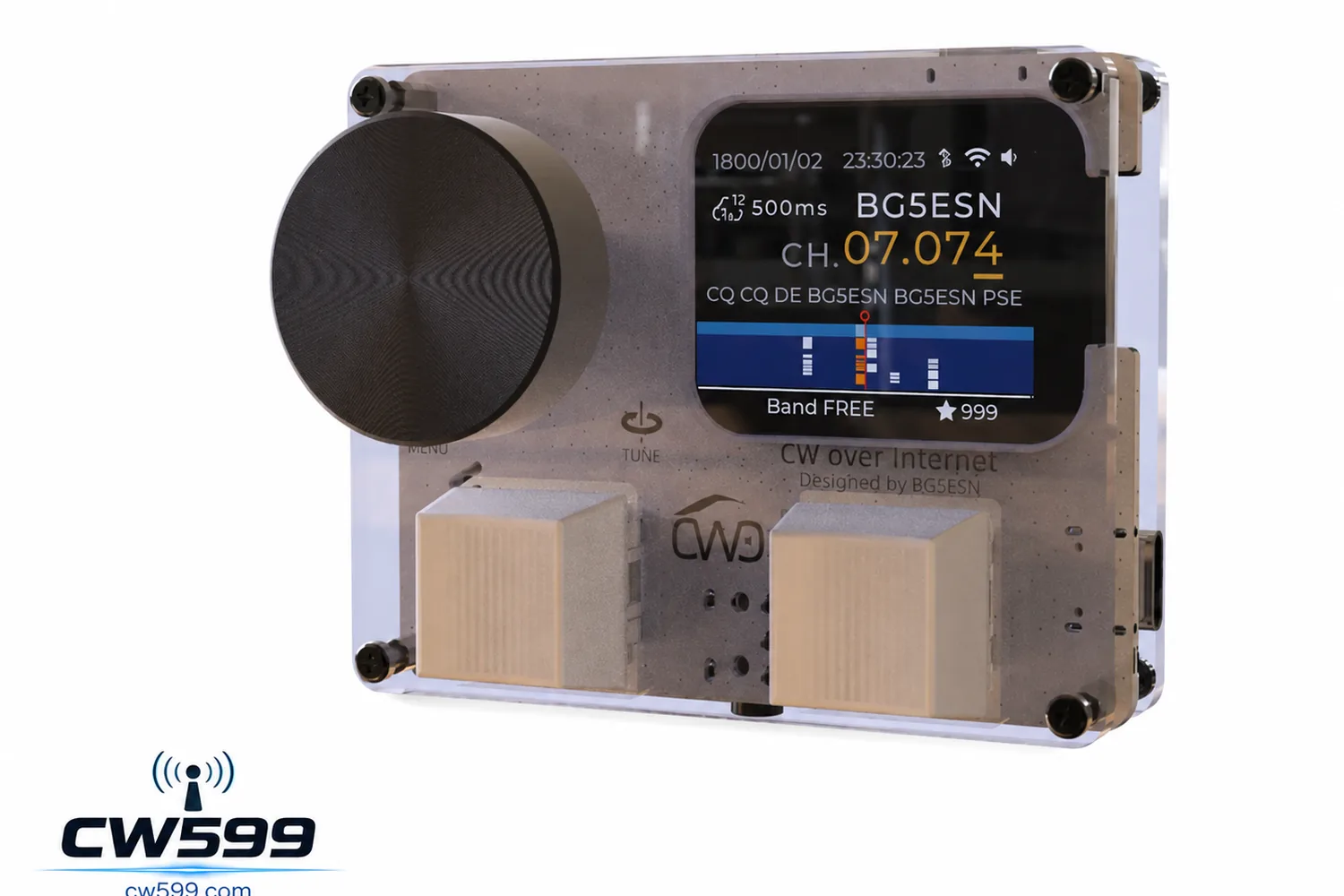
CWO uses dedicated Wi-Fi hardware that can accept a real straight key or paddle. It includes features such as CW decoding, a waterfall display and selectable virtual frequencies.
Its documentation describes the system as a broadcast-style environment designed to simulate real CW operation. Operators can tune around, listen for activity, choose a frequency and communicate much as they would on a radio band.
That makes CWO very different from a normal online chat room.
You are not typing Morse characters into a text box.
You are still sending CW.
How do you use CWO?
After registration and Wi-Fi configuration, the user connects the unit to an available CWO server.
From there, the experience starts to resemble a miniature software-defined radio:
Tune to a virtual frequency.
Look and listen for activity.
Find an unused frequency.
Connect a straight key or paddle.
Call CQ.
Complete a QSO using normal CW procedure.
The current CWO documentation even suggests different sections of its simulated spectrum for different skill levels.
For example, 7.000–7.010 is suggested for roughly 15–20 WPM beginner contacts, while 7.011–7.040 is intended for broader practice. A higher-speed section is also provided where users are encouraged to operate without relying on the decoder, and separate frequencies are available for automated copy practice.
It is therefore more than a Morse tutor.
A better description might be:
a CW band that happens to live on the Internet.
What is CW Hotline?
CW Hotline takes a different approach.
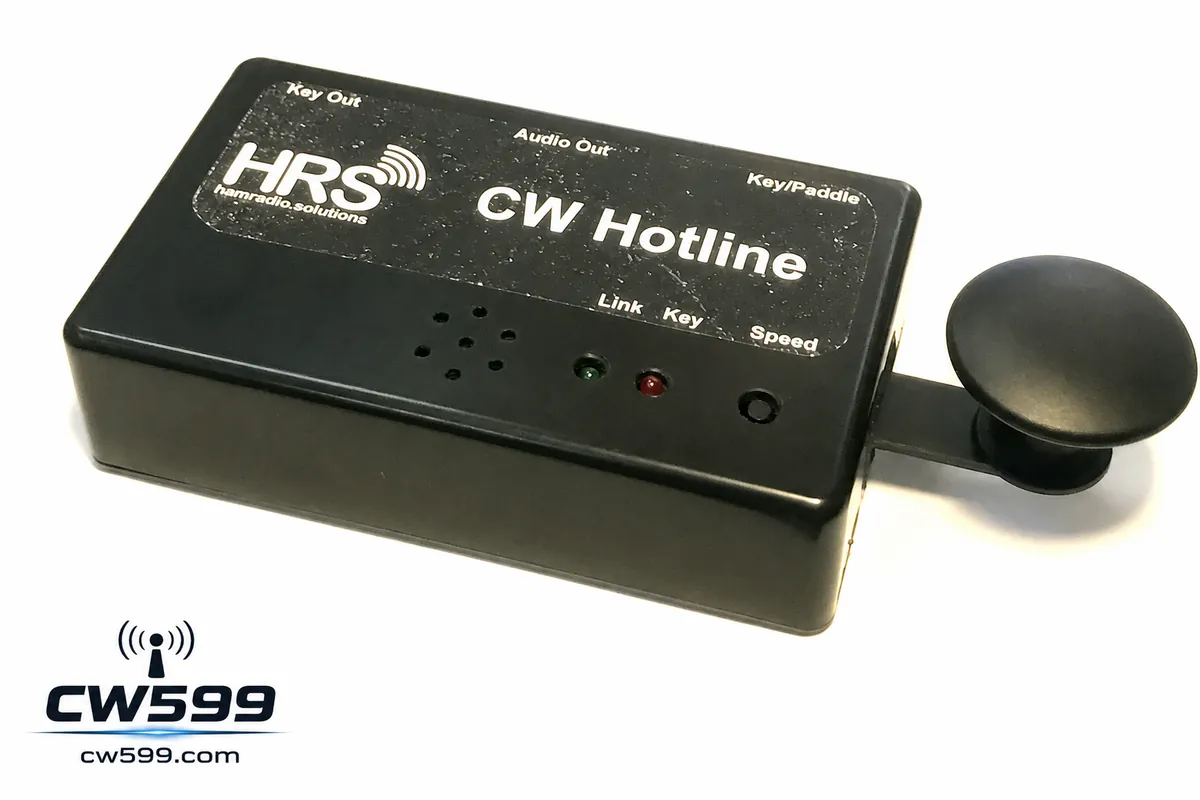
Developed by Ham Radio Solutions, it is a Wi-Fi-connected CW device that the company rather memorably describes as a kind of “Bat Phone” for CW.
Two CW Hotline units can be linked through the Internet.
When one operator keys Morse, the other unit reproduces the sender's timing and “fist” rather than simply transmitting decoded text.
The hardware can work with built-in or external paddles and straight keys, provides sidetone audio, and can also connect to the VBand Internet CW service.
CW Hotline uses a physical keying interface to create a private Internet CW link.
So while CWO feels like entering a public virtual radio band, CW Hotline can feel much more like:
a private telephone line that only speaks Morse code.
The particularly interesting part: remote radio keying
CW Hotline can do something even more interesting.
It provides a keying output for an external transmitter.
That means one unit can sit beside a real radio station while another is located somewhere else.
Your keying actions travel over the Internet to the remote CW Hotline, which then keys the actual transceiver.
Ham Radio Solutions lists low-latency remote CW station keying as one of the system's primary uses.
We can therefore think of modern CW in three different ways.
Traditional CW
Key → radio → antenna → ionosphere → radio
Internet CW
Key → Internet → another Internet CW device
Remote-radio CW
Key → Internet → remote radio → antenna → ionosphere
The path changes.
The operator's hand can remain on the key.
Why does Internet CW matter?
There is a difficult stage in learning Morse that software trainers alone do not completely solve.
You know the alphabet.
You have practiced copying.
Maybe you can copy random callsigns at 15 or 20 WPM.
Then one evening you turn on the radio and hear:
CQ CQ CQ DE ...
And suddenly you do not want to answer.
CW operators sometimes call this key fright.
An ARRL review of CW Hotline described essentially this problem: the author had studied Morse and made some contacts, but still felt that improving required more practice with real people in a lower-pressure environment.
That is where Internet CW becomes particularly valuable.
There is a missing step in the traditional learning path:
Trainer → ? → Real on-air QSO
The question mark can be a practice environment populated by actual humans.
That is where CW Room comes in
This is also part of the reason we created CW Room at CW599.
It shares some ideas with CWO and CW Hotline, but takes another route.
Our starting point was simple:
Do not require special hardware before someone can enter the room.
A browser should be enough.
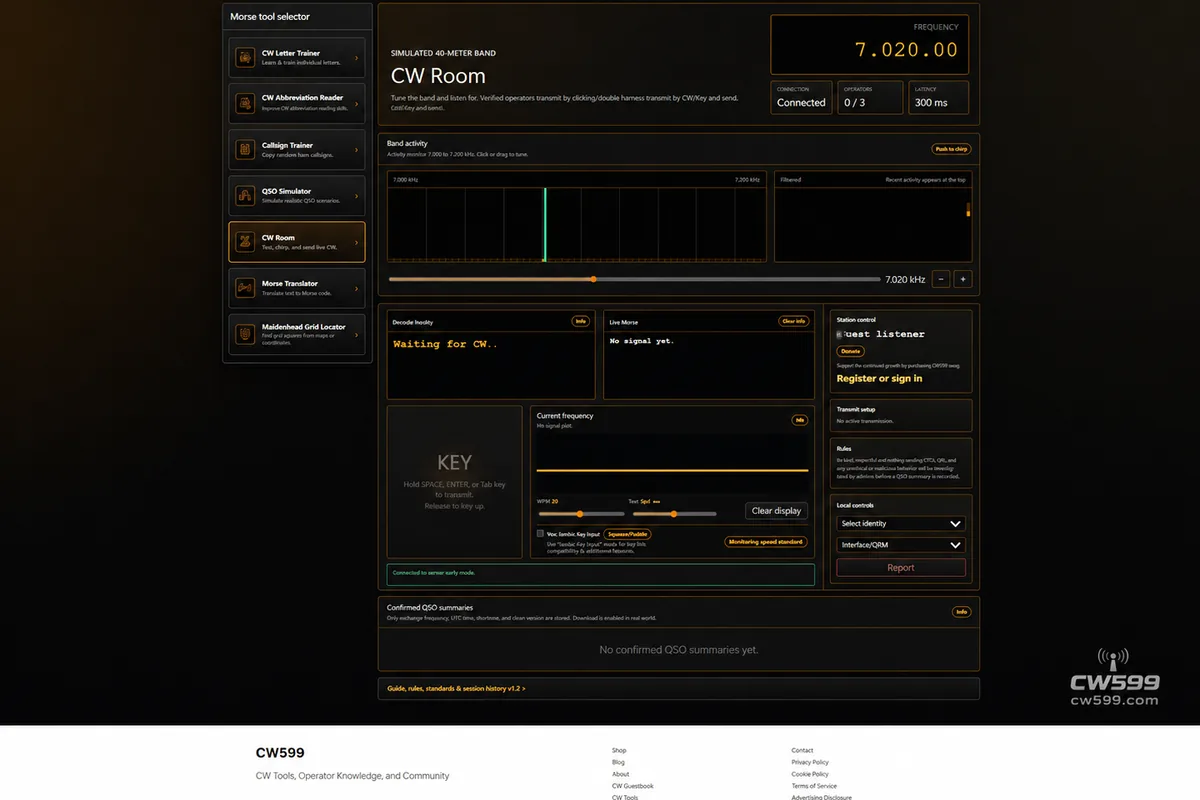
CW Room currently simulates part of the 40-meter CW band from 7.000 to 7.050 MHz. Users can tune by clicking or dragging across the activity display, or by entering a frequency directly. A waterfall-style view shows recent activity.
CW Room brings band activity, tuning, listening, and keying controls into the browser.
It is not a conventional text chat.
There is no message box where you type a sentence and click Send.
If you want to talk, you have to send CW.
How to use CW Room
1. Tune around first
Enter the room and look across 7.000–7.050 MHz.
If you see activity, tune to it and listen.
The basic behavior is intentionally similar to turning the VFO on a real radio.
2. Listen before transmitting
One of the operating principles of CW Room is simple:
Listen first.
Before calling CQ, make sure another QSO is not already taking place on the frequency.
It is partly a technical rule, but it is also practice for good operating behavior on real amateur bands.
3. Use your keyboard as a Morse key
You do not currently need dedicated hardware.
Holding SPACE or ENTER keys the transmitter.
Releasing the key ends the element.
An experimental mobile mode can also use a phone's volume buttons as a Morse key, although support varies between devices and browsers.
So even a phone can become a very primitive CW terminal.
4. Call CQ and make a contact
Find a quiet frequency and send something like:
CQ CQ CQ DE BA7XXX BA7XXX K
Another operator can tune to your frequency and answer:
BA7XXX DE XX1XXX K
From there, the contact can follow normal CW procedure.
Exchange:
Callsigns
RST
QTH
Name
Rig
Antenna
Weather
Or simply have a CW ragchew.
CW Room currently uses a three-seat roundtable model, limiting the number of active transmitters on one frequency to help avoid chaotic overlapping transmissions.
5. Finish the QSO
A completed contact can be closed by sending:
CFSK
At least two authenticated participants must independently confirm the contact before CW Room generates a QSO summary.
The current system stores only summary information such as callsigns, frequency, UTC time, duration and rules version for normal confirmed contacts; decoded conversation content is not retained as the QSO record.
This gives CW Room a little of the feeling of a logbook.
But it is important to be clear about what it is not.
A contact conducted entirely inside CW Room is an Internet CW contact, not an RF amateur-radio QSO.
The purpose is practice and communication, not the creation of artificial DXCC contacts.
CW Room should not replace radio
This principle matters to us.
If CW Room became so convenient that users stopped turning on their radios, we would have built the wrong thing.
The ideal journey looks more like this:
CW Letter Trainer
↓
Callsign Trainer
↓
QSO Simulator
↓
CW Room
↓
Turn on a real transceiver
↓
Complete your first RF CW QSO
This may eventually become one of the most important roles of CW599.
CW Room is not the destination.
It should be the last practice room before you go on the air.
Where could CW Room go next?
The current version is only the beginning of that idea.
There are several directions we would like to explore.
Real Morse keys
Today, SPACE and ENTER can act as keys.
The obvious next step is:
USB interface + straight key or paddle → browser → CW Room
At that point, a Begali paddle, Vibroplex bug, homebrew key or an old military straight key could become an Internet communication device.
And ideally, the system should preserve exactly what makes every operator different:
timing.
spacing.
rhythm.
fist.
Because CW is not fundamentally a sequence of characters.
CW is timing.
Elmer-to-beginner practice
Imagine a learner who has just reached 10 WPM entering a beginner area.
An experienced CW operator is already there, slowly sending:
CQ NEW CW OP
The learner answers.
They make a simple QSO.
The learner makes a mistake.
Nothing terrible happens.
They send a few dits, correct the word and continue.
That psychological difference matters.
Making mistakes on an Internet practice frequency is much easier than overcoming the fear of making them during your first real 40-meter QSO.
CW classrooms
CW Room could eventually support scheduled practice sessions such as:
Beginner CW — 10 WPM
Ragchew — 18 WPM
High Speed CW — 30+ WPM
An instructor could operate with a small roundtable of students.
At that point CW Room stops being just another web utility.
It starts looking more like a permanently open Internet CW club.
A bridge from simulation to radio
The larger vision for CW599 is to connect several currently separate activities:
learning Morse
→ practicing callsigns
→ learning QSO procedure
→ talking to real people through Internet CW
→ understanding your radio
→ getting on the air
Imagine learning CQ on CW599 today.
Practicing a QSO tomorrow.
Making your first human contact in CW Room next week.
Then one evening you close the browser and turn on an FT-710, IC-7300, KX2 or QCX.
You tune around 7 MHz.
Put on your headphones.
And hear:
CQ CQ CQ DE ...
This time, it does not feel unfamiliar.
You answer.
The Internet changes the path, not CW itself
CWO, CW Hotline and CW Room demonstrate something interesting.
CW did not become obsolete when the Internet arrived.
Instead, the Internet gave CW another medium to explore.
CWO turns the Internet into a virtual radio band.
CW Hotline turns it into a Morse cable stretching across cities and countries.
CW Room is trying to lower the entrance barrier even further:
open a browser, tune to a frequency, listen for a while, and start keying.
But eventually we still hope you turn the radio on.
Because a simulated 7.020 MHz does not really have QSB.
It does not have genuine QRM.
Propagation does not suddenly open.
And at two in the morning, a 5-watt station from the other side of the world will not unexpectedly rise out of the noise in your headphones.
The Internet can reproduce many parts of CW.
It cannot reproduce all of radio.
And perhaps that is exactly why radio — and CW — remains so fascinating.
A CW signal report often arrives as three quick digits: 599, 579, 339, or something nearby. Once you know that the digits stand for Readability, Strength, and Tone, the code looks simple. Giving a useful report, however, requires more than repeating 599 to every station.
RST is a compact description of what you actually receive. It tells the other operator whether the message is readable, how strong the signal appears at your receiver, and whether the CW tone sounds clean. The three observations are related, but they are not the same measurement.
The three parts of an RST report
The order is always:
R  S  T
5  7  9
The first digit uses a scale of 1 to 5. The second and third use scales of 1 to 9. For CW, all three digits are normally sent. Voice contacts usually use only R and S.
Readability answers one practical question: How much of the message can you copy?
R
Practical meaning
1
Unreadable
2
Barely readable; occasional words distinguishable
3
Readable with considerable difficulty
4
Readable with practically no difficulty
5
Perfectly readable
Readability is not the same as signal strength. A weak but clean signal in a quiet band may be perfectly readable and deserve R5. A strong signal under heavy interference may be difficult to copy and deserve R3 or R4.
S: Signal strength
Strength describes how strong the signal appears at your receiver.
S
Traditional description
1
Faint; barely perceptible
2
Very weak
3
Weak
4
Fair
5
Fairly good
6
Good
7
Moderately strong
8
Strong
9
Extremely strong
Your receiver's S-meter can help, but an RST report is not a laboratory calibration. S-meters, preamplifiers, attenuation, bandwidth, antennas, noise levels, and local interference all affect the indication. Report what you receive at your station rather than trying to produce an absolute field-strength measurement.
T: Tone
Tone describes the quality and stability of the received CW note.
T
Practical interpretation
1–3
Very rough, broad, or strongly modulated tone
4–6
Noticeable roughness, ripple, or unwanted modulation
7
Near-pure tone with a small imperfection
8
Nearly perfect tone
9
Clean, stable, pure tone
The detailed historical scale refers to transmitter problems that were common when power supplies and oscillators were less stable. Modern equipment usually produces T9 unless it is misadjusted, overdriven, faulty, or affected by another technical problem.
The IARU publication Ethics and Operating Procedures for the Radio Amateur notes that modern operators often use only a few meaningful tone levels. It also identifies chirp and key clicks as common CW defects worth reporting clearly.
What 599 means
599 means:
R5: perfectly readable
S9: extremely strong
T9: clean and stable tone
It is the highest ordinary RST report. If the station is loud, effortless to copy, and clean, 599 is appropriate.
In everyday contacts, 599 should not be treated as a required greeting. A station can still have an excellent QSO with a report of 559, 579, or 339. An honest report gives the other operator more useful information about propagation, antennas, power, and station performance.
What 579 means
579 means:
R5: perfectly readable
S7: moderately strong
T9: clean tone
This is a common realistic report. The signal is easy to copy and sounds clean, but it is not extremely strong. If you can read every character without effort while the S-meter sits below S9, 579 may describe the contact better than 599.
What 339 means
339 means:
R3: readable with considerable difficulty
S3: weak
T9: clean tone
The signal itself is technically clean, but it is weak and difficult to copy. Fading, noise, interference, or limited propagation may force you to request repeats.
A 339 report is not an insult. It tells the transmitting operator that the signal is reaching you and a contact may still be possible, but conditions are difficult. The useful response may be to slow down, repeat important information, adjust the antenna, or try again at another time.
How to send the report in a QSO
A normal exchange can be short:
UR RST 579 579
UR means "your." Repeating the report helps when conditions are noisy. In a compact QSO, one repetition may be enough:
TNX FER CALL UR RST 559
The other operator may acknowledge it with:
R R TNX FER 559
You can practice the order of a contact in the CW599 QSO Simulator. It places RST between the callsign exchange and the name/QTH portion, which helps make the sequence automatic without turning the report itself into a meaningless habit.
Give readability from your ears, not only the meter
The most common beginner mistake is to let the S-meter determine all three digits. The meter may help with S, but it cannot decide R or T for you.
Consider these situations:
A signal peaks at S3 in a quiet band and every character is clear: 539 or 559 may be reasonable.
A signal reaches S8 but is covered by intermittent QRM: readability may fall to R3 or R4.
A strong signal has obvious chirp or clicks: strength can be high while tone quality is not T9.
Deep fading changes the signal during the transmission: report an overall useful impression rather than chasing every meter movement.
Receiving bandwidth also changes the experience. A narrow filter may improve readability in noise, while a very narrow or poorly centered filter can make an otherwise good signal sound weak. Use a normal operating setup and apply consistent judgment.
Chirp, clicks, hum, and other tone problems
A CW signal may change pitch during each element. This is called chirp. Sharp keying transients that spread beyond the intended signal are usually called key clicks. Hum or ripple can make the note sound rough or modulated.
Traditional suffixes include C for chirp and K for clicks, such as 579C or 589K. Those suffixes are not universally understood today. If the problem is important, plain words are clearer:
UR SIG HAS CHIRP
or:
PSE CHECK KEY CLICKS
Be factual and courteous. Do not diagnose the transmitter from one brief reception. First make sure the sound is not caused by your own receiver settings, noise blanker, AGC, overload, or interference. If the defect remains obvious, a calm report can help the other operator find a station problem.
Why contests often use 5NN
In many CW contests, 5NN is sent instead of 599. N is a cut number for 9, so:
5NN = 599
The shorter form saves time in a rapid, predictable exchange. In that context, the report often functions as a standard part of the contest format rather than a detailed assessment of the signal. The rules of the specific event still determine what must be sent and logged.
Do not assume that 5NN should replace every report in an ordinary QSO. Outside a contest, sending the digits that match what you hear is more informative. Beginners should also become comfortable copying full numbers before relying on contest abbreviations.
A practical way to choose an RST
Use this sequence:
Choose R first. Could you copy all of the message, most of it, or only fragments?
Estimate S. Use the meter as a reference, then consider noise, fading, and your normal receiver setup.
Listen to T. Is the note stable and clean? Is there obvious roughness, chirp, hum, or clicking?
Send a stable overall report. Do not change digits for every momentary fade.
Add words when needed.QSB, QRM, QRN, CHIRP, or CLICKS can explain why copying is difficult.
For example:
UR RST 449 QSB
This says the signal is readable with little difficulty, fair in strength, clean in tone, and affected by fading.
Practice honest reporting
When listening to code practice, WebSDR receivers, or live amateur signals, pause before looking at the meter and estimate R first. Then inspect strength and listen specifically for tone quality. This separates the three judgments.
The CW599 Callsign Trainer can strengthen the copying side of the process. Better callsign recognition makes it easier to judge readability instead of confusing unfamiliar character groups with a weak signal.
RST is not a score awarded to the other station. It is a short field report from one receiving position at one moment. Used honestly and courteously, three digits can tell an operator much more than a routine 599.
When you first listen to a real CW contact, you may hear something like:
GM OM TKS FER CALL UR RST 579 FB CPY
You may know every Morse character and still struggle to understand the sentence.
That is because experienced operators rarely send complete written English. CW communication makes extensive use of prosigns, Q codes, abbreviations, number codes, and established operating patterns.
For example:
GM means Good Morning.
FB means Fine Business, or very good.
UR means Your.
RST 579 is a signal report.
CPY means Copy.
73 means Best regards.
Strictly speaking, CW does not have a separate grammar of its own. What operators informally call “CW grammar” is a compact international operating language built from procedural signals, Q codes, shortened words, and shared conventions. The IARU operating guide identifies Q codes, abbreviations, and prosigns as the primary shortcuts that make CW communication faster and more efficient. (IARU Region 1)
This guide covers the internationally recognized expressions you are most likely to hear during amateur-radio CW contacts. It does not attempt to include every local net code, club abbreviation, or specialized traffic-handling signal.
Prosigns control the procedure of a contact. They may mean “wait,” “go ahead,” “end of transmission,” or “end of contact.”
A true two-letter prosign is normally sent as one continuous Morse character without the usual space between the letters. It may be written as <AR> or with a bar above the letters.
Q Codes
Q codes are three-letter groups beginning with Q:
QTH: location
QRM: interference
QRS: send more slowly
QSL: acknowledgment
QSO: a radio contact
Adding a question mark normally changes a Q code into a question:
QRL?
Is this frequency in use?
QRL
This frequency is in use.
ARRL describes this question-versus-statement convention in its operating references. (ARRL)
Common CW Abbreviations
These are shortened ordinary words:
GM = Good Morning
FB = Fine Business
TKS = Thanks
FER = For
UR = Your
WX = Weather
They are sent as normal letters with normal spacing.
Number Codes and Contest Shorthand
Examples include:
73: Best regards
88: Love and kisses
5NN: 599
T: 0
A: 1
N: 9
Some are heard in ordinary ragchews, while others are mainly used in contests and DX pileups.
Essential CW Procedural Signals
Signal
Meaning
Typical use
CQ
General call to any station
CQ CQ DE BA7MTH BA7MTH AR
DE
From, this is
W1ABC DE BA7MTH
<AR>
End of message or transmission
Common at the end of a CQ
K
Go ahead
Invites a response
KN
Go ahead, named station only
Excludes other callers
BK
Break
Fast back-and-forth exchange
<AS>
Wait or stand by
Requests a short delay
<SK>
End of contact
Ends the complete QSO
<CL>
Closing the station
Sent before leaving the air
<BT> or =
Separator or thinking pause
Separates subjects or text sections
<HH>
Error
Cancels an error before retransmission
SOS
Distress signal
Genuine emergencies only
Under the strict IARU definition, a prosign combines two characters without an inter-character space. AR, AS, SK, CL, and HH are therefore true prosigns. BK and KN are sent with normal spacing between their two letters, so the IARU guide does not classify them as true combined-character prosigns, although many operating guides group them together informally.
AR, K, KN, and SK
<AR> means that the current transmission or message has ended. It is especially appropriate at the end of a general call:
CQ CQ DE BA7MTH BA7MTH AR
At this point there is no specific station to whom the frequency is being handed, so the IARU guide recommends AR rather than K at the end of a CQ. (IARU Region 1)
K hands the conversation to the other station:
W1ABC DE BA7MTH K
KN means that only the station just named should answer:
W1ABC DE BA7MTH KN
<SK> ends the entire contact:
TKS FER QSO 73 ES CUL W1ABC DE BA7MTH SK
<CL> indicates that the operator is also closing the station:
W1ABC DE BA7MTH SK CL
The IARU guide recommends avoiding combinations such as AR K, AR KN, and AR SK, because they unnecessarily combine “end of transmission” with another closing or handover instruction. (IARU Region 1)
Common Amateur-Radio Q Codes
Frequency, Interference, and Propagation
Code
Question
Statement
QRG
What is my exact frequency?
Your exact frequency is…
QRH
Is my frequency varying?
Your frequency is varying
QRL
Are you busy? Is the frequency in use?
I am busy; the frequency is in use
QRM
Am I being interfered with?
I am experiencing interference
QRN
Are you troubled by static?
I am troubled by static or natural noise
QSB
Are my signals fading?
Your signals are fading
QSA
What is my signal strength?
Your strength is 1 through 5
Before calling CQ on an apparently clear frequency, send:
QRL?
Then listen before transmitting again. The IARU guide identifies this as an important operating practice. (IARU Region 1)
Speed, Power, and Operating Status
Code
Common meaning
QRO
Increase power; also used informally for high-power operation
QRP
Reduce power; also used for low-power operation
QRQ
Send faster
QRS
Send more slowly
QRT
Stop sending, close down, or leave the air
QRV
Ready
QRX
Wait, call again later, or call again at a specified time
QSK
Break-in operation; reception between transmitted elements
Calling and Communication
Code
Common meaning
QRZ?
Who is calling me?
QSO
Communicate with another station; a radio contact
QSP
Relay a message
QSX
Listen on a specified frequency
QSY
Change frequency
QTC
Messages or formal traffic to send
QRU
I have nothing for you
QSL
Acknowledge receipt; confirmation of a contact
QTH
Station location
QTR
Correct time
QRA
Station name, although NAME is more common in casual QSOs
ARRL’s operating references list QRG, QRL, QRM, QRN, QRO, QRP, QRQ, QRS, QRT, QRV, QRX, QRZ, QSB, QSK, QSL, QSO, QSP, QSX, QSY, QTC, QTH, and QTR among the commonly used amateur Q signals. (ARRL)
QRZ Is Not CQ
QRZ? means:
Who is calling me?
It does not mean “Is anyone there?” To invite calls from any station, use CQ.
QSL can appear in several related ways:
QSL?
Can you acknowledge receipt?
QSL
I acknowledge receipt.
QSL VIA BURO
Please exchange the QSL card through the bureau.
Common CW Abbreviations
Greetings and Social Expressions
Abbreviation
Full expression
Meaning
GM
Good Morning
Morning greeting
GA
Good Afternoon
Afternoon greeting; may also mean Go Ahead
GE
Good Evening
Evening greeting
GN
Good Night
Good night
GD
Good / Good Day
Good
FB
Fine Business
Very good, excellent
UFB
Ultra Fine Business
Extremely good
GUD
Good
Good
VY
Very
Very
HI
Laughter
The CW equivalent of “ha ha”
HNY
Happy New Year
New Year greeting
MX
Merry Christmas
Christmas greeting
XMAS
Christmas
Christmas
GL
Good Luck
Good luck
CU
See You
See you
CUL
See You Later
See you later
73
Best Regards
Friendly closing wishes
88
Love and Kisses
Traditionally used for someone close
In CW, FB does not mean Facebook. Fine Business is a traditional telegraph expression meaning that something is good, satisfactory, or excellent.
FB CPY UR SIGS
means:
I am copying your signals very well.
The IARU abbreviation list includes FB, UFB, GM, GA, GE, GN, HI, HNY, MX, 73, and 88. It also notes that 73 is already a complete expression and should not be pluralized as “73s.” (IARU Region 1)
Thanks, Confirmation, and Requests
Abbreviation
Full expression
Meaning
TU
Thank You
Thank you
TKS
Thanks
Thanks
TNX
Thanks
Thanks
PSE
Please
Please
SRI
Sorry
Sorry
R
Roger / Received
Received and understood
RR
Roger Roger
Fully received
CFM
Confirm
Confirm
OK
All correct
Correct
CPY
Copy
Copy or understand
CPI
Copy
Copy or understand
AGN
Again
Again
RPT
Repeat
Repeat
RPRT
Report
Report
NIL
Nothing
Nothing received or nothing available
HW
How
How
Common combinations include:
PSE AGN
Please send it again.
PSE QRS
Please send more slowly.
SRI NIL CPY
Sorry, I copied nothing.
HW CPY?
How are you copying me?
TKS FER RPRT
Thanks for the report.
Connecting Words
Abbreviation
Full expression
Meaning
DE
From
From, this is
ES
And
And
FER
For
For
UR
Your
Your
U
You
You
WID
With
With
ABT
About
About or approximately
B4
Before
Before
BTW
By The Way
By the way
HR
Here
Here
NW
Now
Now
MNI
Many
Many
HVE, HV
Have
Have
HPE
Hope
Hope
TMW, TMRW
Tomorrow
Tomorrow
NR
Number / Near
Meaning depends on context
DR
Dear
Dear
Examples:
MNI TKS FER UR CALL
Many thanks for your call.
WX HR SUNNY ES WARM
The weather here is sunny and warm.
HPE CU AGN
I hope to contact you again.
Operators, Equipment, and Station Information
Abbreviation
Full expression
Meaning
OM
Old Man
Traditional friendly term for a male amateur
YL
Young Lady
Female operator
XYL
Wife / Spouse
Traditional term for a spouse
OP, OPR
Operator
Operator
ANT
Antenna
Antenna
PWR
Power
Transmitter power
TX
Transmitter / Transmit
Transmitter or transmitting
RX
Receiver / Receive
Receiver or receiving
TRX, XCVR
Transceiver
Transceiver
RIG
Radio equipment
Station equipment
SIG, SIGS
Signal / Signals
Signal or signals
FREQ
Frequency
Frequency
CNDX, CONDX
Conditions
Propagation or operating conditions
WX
Weather
Weather
TEMP
Temperature
Temperature
WPM
Words Per Minute
Sending speed
LP
Long Path
Long-path propagation
SP
Short Path
Short-path propagation
SKED
Schedule
Arranged contact
WKD
Worked
Contacted
WKG
Working
Working or contacting
HRD
Heard
Heard
The IARU list includes ANT, PWR, TX, RX, TRX, RIG, WX, OP, OPR, LP, SP, and SKED among its commonly used CW abbreviations. (IARU Region 1)
RST Reports and 5NN
A CW signal report normally contains three digits:
R — Readability: 1 to 5
S — Signal strength: 1 to 9
T — Tone quality: 1 to 9
For example:
UR RST 579
means readability 5, strength 7, and tone 9.
UR RST 599
indicates a fully readable, strong signal with a clean tone.
In contests, 599 is often shortened to:
5NN
The Morse character N is much shorter than the numeral 9. ARRL contest material describes 5NN as a widely understood abbreviation for 599. (IARU Region 1)
Common Cut Numbers
Letter
Number
A
1
N
9
T
0
For example:
5NN ATT
can mean:
599 100
ARRL advises operators not to overuse unusual cut numbers. While 5NN and the substitutions A, N, and T are commonly recognized, excessive compression may cause requests for repeats and eliminate any time saved. (ARRL)
DX, Pileup, and Contest Expressions
Expression
Meaning
DX
A distant or foreign station
CQ DX
General call for distant stations
CQ JA
Call for Japanese stations
CQ NA
Call for North American stations
CQ EU
Call for European stations
CQ TEST
Contest call
TEST
Contest
UP
Listening above the transmit frequency
DWN
Listening below the transmit frequency
UP 2
Listening about 2 kHz higher
UP 5/10
Listening 5 to 10 kHz higher
QSX 7015
Listening on 7015 kHz
SPLIT
Transmitting and receiving on different frequencies
NR
Contest serial number
ZONE
Contest zone
DUP
Duplicate contact
NIL
Not copied or not found in the log
BURO
QSL bureau
DIRECT
Direct postal QSL exchange
CQ TEST is a contest call, with TEST serving as an abbreviation for Contest. A DX station working split may send UP, DWN, UP 5, or QSX 3515 after each contact to indicate where it is listening. (ARRL)
Anatomy of a Typical CW QSO
The following example uses BA7MTH and W1ABC.
Checking the Frequency
QRL?
If nobody answers, the operator begins calling.
Calling CQ
CQ CQ DE BA7MTH BA7MTH AR
Translation:
Calling any station. This is BA7MTH, BA7MTH. End of call.
Answering
BA7MTH DE W1ABC W1ABC AR
Translation:
BA7MTH, this is W1ABC.
First Information Exchange
W1ABC DE BA7MTH GM TKS FER CALL
UR RST 579 579
NAME JANGEL JANGEL
QTH SHANTOU SHANTOU
HW CPY?
W1ABC DE BA7MTH K
In normal English:
W1ABC, this is BA7MTH. Good morning and thanks for the call. Your signal report is 579. My name is Jangel and my location is Shantou. How are you copying me? W1ABC, this is BA7MTH. Go ahead.
The Reply
BA7MTH DE W1ABC
FB JANGEL TKS FER RPRT
UR RST 589 589
NAME TOM TOM
QTH BOSTON BOSTON
WX SUNNY TEMP 22C
BA7MTH DE W1ABC K
Translation:
BA7MTH, this is W1ABC. Very good, Jangel, and thanks for the report. Your signal is 589. My name is Tom, my location is Boston, and the weather is sunny with a temperature of 22°C. Go ahead.
Ending the Contact
W1ABC DE BA7MTH
FB TOM ALL CPY
TKS FER QSO
73 ES CUL
W1ABC DE BA7MTH SK
Translation:
W1ABC, this is BA7MTH. Very good, Tom. I copied everything. Thanks for the contact. Best regards and see you later. End of contact.
This follows the general structure of the beginner CW QSO presented in the IARU operating guide: callsigns, greeting, RST, name, QTH, equipment or weather information, followed by 73, CUL, and SK. (IARU Region 1)
CW Sentences Do Not Need Complete English Grammar
A complete English sentence might be:
Good morning. Thank you very much for calling me. Your signal report is 579. My name is Jangel and my location is Shantou. How are you copying me?
A typical CW version is:
GM TKS VY MCH FER CALL UR RST 579
NAME JANGEL QTH SHANTOU HW CPY?
It may be shortened even further:
GM TNX CALL 579 JANGEL SHANTOU HW?
When the context is clear, operators omit articles, pronouns, linking verbs, punctuation, and sometimes repeated callsigns.
The objective is not perfect written English. It is:
To exchange accurate information with the fewest characters that both operators can understand.
Common Beginner Mistakes
Running Ordinary Abbreviations Together
FB, GM, and TKS are ordinary abbreviations. Send them as separate letters. Only true prosigns such as <AR>, <AS>, and <SK> are run together.
Using QRZ Instead of CQ
QRZ means “Who is calling me?” It is not a general call.
Failing to Send QRL? Before Calling
A frequency that sounds quiet at your location may still be in use. You may hear only one side of a contact because of propagation, weak signals, or split-frequency operation.
Answering a Slow Station at High Speed
Do not answer a CQ at a speed higher than the calling operator can reliably copy. The IARU guide explicitly recommends matching or staying below the calling station’s speed. (IARU Region 1)
Ending Every Transmission with AR K
Once a QSO has been established, K or KN is normally sufficient to hand over the frequency.
Sending “73s”
73 is already a complete traditional expression. It does not need a plural ending.
Making Shorthand Harder Than Plain Language
Abbreviations are useful only when the other operator understands them. When the other station sends:
AGN?
or simply:
?
slow down, use more complete words, and repeat the essential information.
Conclusion
Learning the Morse alphabet teaches you how CW sounds. Learning the common operating language teaches you how to communicate.
A beginner should first become comfortable with:
CQ  DE  AR  K  KN  SK
QRL  QRM  QRN  QRS  QRZ  QSL  QSO  QTH
GM  FB  TKS  FER  UR  RST  NAME  WX
AGN  PSE  SRI  CPY  HW  TU  73
Once you recognize these expressions, you can understand most ordinary CW contacts. The rest becomes familiar through listening and real on-air experience.
CW may sound like a stream of short tones, but to experienced operators it is a shared language that crosses national borders, accents, and spoken-language barriers.
If you operate FT8, amateur satellites, or VHF contests, you have probably seen codes such as:
FN31, EM48, JO20DB, or IN55CC
These codes are not callsigns or special Morse abbreviations. They are Maidenhead Grid Locators, also commonly called grid squares, QTH locators, or IARU locators.
But are Maidenhead grid locators also used in traditional CW contacts?
The answer is:
Yes, Maidenhead locators can be sent in CW, but whether you need to send one depends on the band, activity, and contest rules—not on the CW mode itself.
What Is a Maidenhead Grid Locator?
The Maidenhead Locator System is an alphanumeric system used by radio amateurs to describe station locations without transmitting a long latitude and longitude.
A locator may look like:
FN31
FN31PR
JO20DB
IN55CC
According to the IARU Region 1 VHF Handbook, the worldwide locator system was originally defined in 1980. The initial specification used six characters, with a shortened four-character option intended for HF use. Longer locators can be used when greater accuracy is needed, particularly for microwave activity.
Common locator lengths include:
Format
Example
Typical Use
4 characters
FN31
General area identification and some contest exchanges
6 characters
FN31PR
VHF/UHF, portable operation, satellites, and contests
8 characters
FN31PR12
Higher-precision location reporting
At mid-latitudes, a four-character locator identifies an area with a positional accuracy of roughly 80 kilometres, while a six-character locator narrows the location to approximately 3 kilometres.
A grid locator therefore provides useful geographic information without normally revealing an exact street address.
Is a Grid Locator Required in a Normal HF CW QSO?
Usually, no.
A traditional conversational HF CW contact often includes:
Callsign
RST report
Operator name
City or general QTH
Transmitter power
Antenna
Weather
QSL information
For example:
UR RST 579 579 NAME TOM TOM QTH LONDON LONDON
For this type of everyday CW QSO, a town, city, or region is normally sufficient. There is no universal rule requiring every HF CW operator to send a Maidenhead grid.
If the other operator does not ask for your grid and the activity rules do not require it, you may leave it out.
However, the original locator specification included a four-character format specifically suitable for HF use. A short grid can be useful when signals are weak, when language differences make place names difficult to copy, or when operators want to exchange location information with fewer characters.
When Are Maidenhead Locators Commonly Used in CW?
1. VHF, UHF, and Microwave CW Contacts
On VHF and higher frequencies, the station’s geographic position is often more useful than the name of the nearest city.
The IARU operating guide states that exchanging a QTH locator is customary during CW contacts on VHF and above. It allows an operator to estimate the direction and distance to the other station quickly. (IARU R1)
Location is particularly important when working with:
Directional antennas
Tropospheric propagation
Terrain-sensitive paths
Aircraft scatter
Meteor scatter
Auroral propagation
Earth–Moon–Earth communication
Microwave links
In these situations, knowing the other station’s grid may be much more useful than knowing only the country or city.
2. VHF and UHF CW Contests
Many VHF, UHF, and microwave contests require a grid locator as part of the official exchange.
For example, IARU Region 1 contest rules specify that CW, SSB, or FM contacts may include an RST report, a serial number, and the complete six-character QTH locator.
A typical exchange may look like:
599 003 JO20DB
In this example:
599 is the RST report
003 is the contact serial number
JO20DB is the six-character Maidenhead locator
Some contest scores are based on the distance between stations and the number of different locator squares worked.
Rules vary between events. Some require four-character grids, while others require six characters or additional information. Always check the official rules before operating.
3. Amateur Satellites, EME, and Weak-Signal Communication
Grid locators are also widely used in:
Amateur satellite contacts
EME, or moonbounce
Meteor scatter
Aircraft scatter
Microwave operation
VHF/UHF weak-signal work
The IARU operating guide lists satellite, EME, meteor scatter, and auroral communication among the specialised activities commonly found on VHF and higher bands.
The ARRL International EME Contest, for example, requires stations to exchange four-character Maidenhead grid locators. Each unique grid can also count as a score multiplier. (美国业余无线电联盟)
This applies regardless of whether the contact is completed using CW, voice, or another permitted mode.
4. Portable, Mobile, and Rover Operation
A fixed home station will usually remain in the same locator. A portable or mobile operator may cross into a different grid during the same trip.
Grid information is therefore especially useful for:
Portable QRP operation
Field stations
Mobile CW
Rover contests
Hilltop operation
Grid-expedition activity
Travel and holiday operation
When operating away from home, use the locator of the actual transmitting location—not the locator stored for your home station.
This matters for contest scoring, distance calculations, QSL confirmations, and station-location records.
Should You Send a Four- or Six-Character Locator?
The correct length depends on the activity.
Use a Four-Character Locator When:
Only a broad geographic area is needed
You are making a general HF contact
The contest rules require four characters
Signals are extremely weak and the exchange must remain short
The other operator asks only for your grid square
Example:
QTH FN31
Use a Six-Character Locator When:
Operating on VHF, UHF, or microwave bands
Working amateur satellites or EME
Operating portable or as a rover
More accurate distance calculation is needed
The contest rules require six characters
Example:
QTH FN31PR
The six-character locator is now the most common full-length format and provides a practical balance between transmission length and geographic precision.
How Can You Send a Grid Locator in CW?
During a casual CW QSO, the grid can be included with your QTH information:
NAME TOM TOM QTH BOSTON BOSTON GRID FN42 FN42
A shorter version is also easy to understand:
QTH FN42PR
During a contest, follow the exact exchange format required by the rules:
599 023 FN42PR
Avoid adding unnecessary information during a contest exchange. A predictable format makes it easier for the other operator to copy the locator correctly.
Because Maidenhead locators contain both letters and numbers, pay particular attention to:
Correct character spacing
The difference between the letter O and zero
The difference between the letter I and one
Repeating the complete locator when a fill is requested
Recording locators in uppercase in your log
How Do You Find Your Maidenhead Grid Locator?
Memorising latitude and longitude is not practical for everyday operation. A locator tool can convert or verify a station position in the standard Maidenhead format.
CW599 has added its sixth CW utility:
Maidenhead Grid Locator
Use it to find or check your grid before operating portable, entering a contest, or creating a new station location in your logging software.
A Maidenhead locator is not required in every CW QSO, but it can be essential in VHF/UHF operation, microwave work, satellites, EME, rover activity, and distance-based contests.
For an ordinary HF CW conversation, sending your city or general QTH is normally enough. When the other operator asks for your grid, your operating position has changed, or the contest rules require one, you should send the correct four- or six-character locator.
Even if you currently operate mainly on HF, it is worth knowing your home grid. Maidenhead locators are widely used in modern amateur-radio logging, awards, contests, station records, and contact confirmations.
Before your next portable or contest operation, use the CW599 Maidenhead Grid Locator to verify the correct grid for your operating position.
Calling CQ on CW can feel harder than learning the characters. The difficult part is rarely the phrase CQ CQ CQ. It is knowing when to transmit, what comes next, and how to recover when the reply is not perfectly clear.
A first contact does not need to be long. If both operators exchange callsigns, signal reports, names, locations, and a courteous closing, the QSO is already complete.
Before transmitting: listen first
Find a frequency that sounds clear and listen for long enough to understand whether another station is using it. A weak station, a station between transmissions, or a split operation may be easy to miss.
Depending on local practice and band conditions, an operator may ask whether the frequency is in use:
QRL? DE BA7MTH
QRL? asks whether the frequency is busy. Send it once or twice, then listen. If another operator answers QRL, C, or otherwise indicates activity, move to another frequency.
Two or three repetitions of CQ and two repetitions of your callsign are usually enough. Long, continuous calls occupy the frequency and can make it harder to hear a station that is trying to answer.
After the call, listen. If no one answers, wait briefly and call again. Adjusting the receiver bandwidth or tuning around your transmit frequency can help you hear a slightly off-frequency reply.
How to answer a CQ
Suppose BA7MTH is calling and K1ABC wants to answer:
BA7MTH DE K1ABC K1ABC AR
The called station's callsign comes first, followed by DE, then the answering station's callsign. Repeating your own callsign helps in noise or fading.
Some operators use a shorter answer:
BA7MTH DE K1ABC K
Both are understandable. Match the pace of the station you are calling, and do not answer faster than you can comfortably receive.
The first exchange
If BA7MTH copied the caller, a friendly first transmission might be:
K1ABC DE BA7MTH
GM TNX FER CALL
UR RST 579 579
NAME JOHN JOHN
QTH GUANGZHOU GUANGZHOU
HW?
K1ABC DE BA7MTH KN
In plain language:
Good morning, thanks for the call.
Your report is 579.
My name is John.
My location is Guangzhou.
How did you copy?
Only K1ABC is invited to answer.
KN is useful after contact has been established because it invites only the named station to transmit. The ARRL operating aid distinguishes K, which invites any station, from KN, which invites only the specific station in contact.
How to give an RST report
For CW, RST normally contains three digits:
R, readability: 1 to 5
S, signal strength: 1 to 9
T, tone: 1 to 9
599 means perfectly readable, extremely strong, and a very pure tone. It is common in short or contest-style contacts, but a useful report should reflect what you actually hear.
If the signal is easy to read but not very strong, 579 may be more informative. Do not worry about making the report scientifically precise. Its value is as an honest operating observation.
A complete short QSO
Here is a compact example with both sides:
BA7MTH:
CQ CQ CQ DE BA7MTH BA7MTH K

K1ABC:
BA7MTH DE K1ABC K1ABC AR

BA7MTH:
K1ABC DE BA7MTH
TNX FER CALL
UR RST 579
NAME JOHN
QTH GUANGZHOU
HW?
K1ABC DE BA7MTH KN

K1ABC:
BA7MTH DE K1ABC
R R TNX JOHN
UR RST 569
NAME MIKE
QTH BOSTON
73 ES TNX QSO
BA7MTH DE K1ABC KN

BA7MTH:
K1ABC DE BA7MTH
R TNX MIKE
73 ES HPE CUAGN
K1ABC DE BA7MTH SK
The wording can vary. CW operating is not a form that must be recited exactly. The structure matters more:
Identify both stations.
Send one manageable block of information.
Invite the other station.
Acknowledge what was received.
Close clearly.
If you missed part of the reply
Real signals fade. Noise, interference, and unfamiliar sending styles can remove a character or an entire word. Asking for a repeat is normal operating, not a failure.
Useful requests include:
AGN?             Send again
CALL?            Repeat callsign
RST?             Repeat signal report
NAME?            Repeat name
QTH?             Repeat location
PSE QRS          Please send more slowly
If only one item is missing, ask for that item rather than requesting the entire transmission again.
When a partial callsign was heard, send what you copied:
K1?BC AGN?
This tells the caller which part is already known.
Sending speed and spacing
Send at a speed you can also copy. A clean 10 WPM contact is better than an unreadable 20 WPM contact.
If a slower station answers your CQ, reduce your speed. Good spacing is especially important when slowing down. Do not stretch every dit and dah into a very long element. Keep recognizable character rhythm and add more space between characters and words.
How to close the contact
A courteous close can be brief:
TNX QSO 73
K1ABC DE BA7MTH SK
73 expresses best regards. SK marks the end of the contact. If the station is going off the air entirely, some operators also use CL.
Do not send SK after every turn. It is a closing signal for the QSO, not a general invitation to transmit.
Practice before going on the air
The CW599 QSO Simulator lets you rehearse the order of CQ, RST, name, QTH, and 73 without pressure. Focus on recognizing the exchange rather than memorizing one exact script.
The CW Room is a development preview for live browser-based CW. You can listen as a guest; transmitting requires a signed-in, verified callsign. It is useful for testing timing and shared-frequency behavior, but it does not replace an amateur-radio license or compliance with radio regulations.
A first-QSO checklist
Before calling:
Listen carefully.
Check whether the frequency is in use.
Set a comfortable sidetone and receive bandwidth.
Know the information you plan to send.
During the QSO:
Identify both stations.
Send short blocks.
Use K or KN appropriately.
Ask for repeats when needed.
Match the other operator's speed.
At the end:
Confirm the essential information.
Send 73.
Close with both callsigns and SK.
Record the contact in your log.
The first CQ feels significant because it turns private practice into communication. Keep the call short, listen carefully, and remember that the operator answering you also wants the contact to succeed.
I got into amateur radio in the summer of 2021. Before that, I was flying FPV drones. Because I was already playing with antennas, the algorithm on Bilibili recommended me a video from a ham in Chengdu—making contacts with stations all over the world from inside his car.
That moment completely changed my understanding.
My first impression of amateur radio was simple: → You can talk to the world.
After nearly a year of waiting, studying, and going through the process, I finally obtained my licenses in 2022—what we casually call the “driver’s license and registration” of the ham world.
But this article is about something more interesting:
What can you legally do in amateur radio before getting licensed in China?
⚠️ Important: In China, transmitting (pressing the PTT) without a license is illegal. However, listening is allowed—as long as you don’t redistribute what you hear.
Understanding Amateur Radio Licensing in China
Before diving in, here’s a quick overview of how licensing works in China:
China uses a three-tier licensing system:
Class A (Beginner) – Entry-level license
Limited frequency access (mainly VHF/UHF)
Lower power limits
Suitable for local communication and repeaters
Class B (Intermediate)
Access to more bands, including parts of HF
Higher power and more flexibility
Class C (Advanced)
Full privileges, including most HF bands
Suitable for long-distance (DX) communication
In addition to the operator certificate, you also need a station license to legally transmit.
What You Can Do Before Getting Licensed
Here are six practical ways I explored amateur radio before I was licensed:
1. Listening with a Handheld Radio (HT)
My first device was a legendary budget handheld—yes, one of those ~$15 radios.
Even without transmitting, you can:
Listen to local repeaters
Learn operating etiquette
Understand real conversations between hams
Pro tip:
Single-band listening often gives better sensitivity than dual-watch mode
You can even try receiving satellite signals with the stock antenna
You’ll quickly realize: Amateur radio is not just about talking—it’s about understanding the invisible world around you.
2. Explore the Spectrum with an SDR
Discovering SDR (Software Defined Radio) was a turning point.
With a simple USB SDR, you can:
Scan from ~10 kHz to 2 GHz
Visualize signals in real time
Explore aviation, marine, broadcast, and more
This is where you start learning:
Antenna types
SWR (standing wave ratio)
Wavelength relationships
And most importantly:
You begin to understand whether HF (shortwave) is for you.
3. Try Satellite Listening
Yes—this works even with a cheap handheld.
With apps like:
Look4Sat
ISS Detector
You can:
Track satellites using your phone
Receive signals from orbit
Decode SSTV images from satellites
⚠️ Tip: Do this in a quiet, open space. Walking around with antennas can attract attention if you’re not licensed yet.
4. Use WebSDR (Listen Globally via Internet)
If your local environment limits you, WebSDR opens the world.
You can:
Access receivers in Europe or the US
Compare signal quality across regions
Experience real HF propagation
It’s a humbling reminder:
Geography and antennas matter—a lot.
5. Connect with Other Hams
One of the most surprising parts of this hobby:
“Hams help each other.”
Through satellite listening, I met my first mentor—who guided me into satellite operations and introduced me to communities.
Even before getting licensed, you can:
Join local groups (WeChat, forums, clubs)
Learn from experienced operators
Understand local repeater culture
6. Prepare for the Exam
This is the most important step.
In China:
Exams are organized by provincial radio associations
Registration is usually announced via websites and social media
The exam itself is not difficult—but requires preparation
My experience:
~15 minutes to complete
~1 month waiting for results
One of the happiest moments when I passed
Final Thoughts
Looking back, the year before getting licensed was not “waiting time” at all.
It was:
Exploration
Learning
Curiosity-driven discovery
If you’re preparing for your Class A license:
Don’t wait. Start playing the radio—legally—today.
About the Author
I’m the creator of CW599, a project focused on sharing the beauty of CW (Morse code) and amateur radio with a global audience.
From listening on a cheap handheld to building my own station, this journey started with curiosity—and it’s still evolving.