If you are learning CW, setting up a radio menu, researching electronic keys, or comparing different amateur radio callsigns, you will probably come across the term CW Weight.
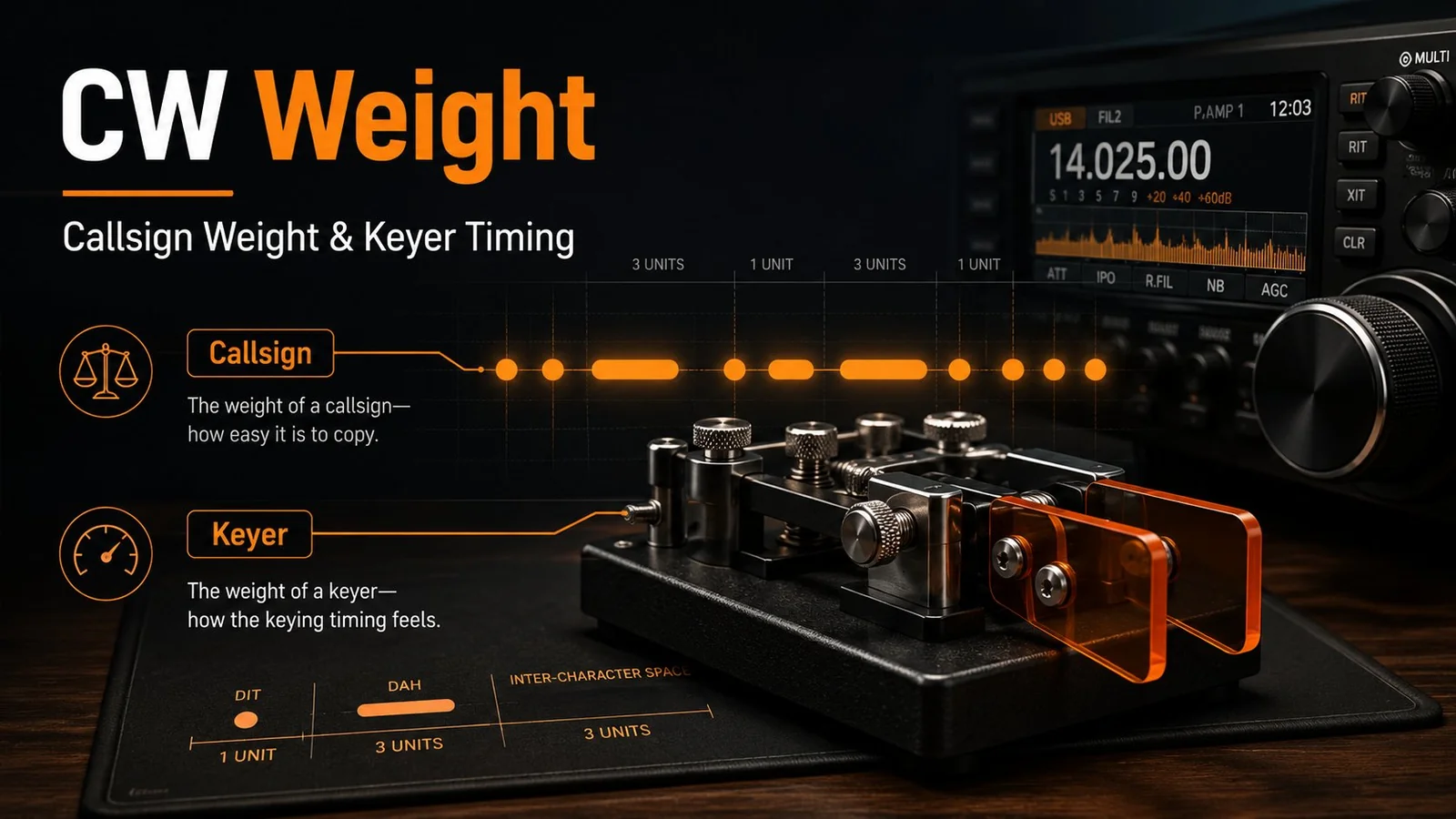
At first it can be confusing, because "weight" here does not mean physical mass. In amateur radio, CW weight usually refers to one of two different things:
- The time a callsign takes to send in Morse code, often called callsign weight.
- A setting in a radio or electronic keyer that adjusts the timing ratio between dots and dashes.
Both ideas are related to Morse code timing, but they describe very different things.
What does CW mean?
CW stands for Continuous Wave.
In amateur radio, CW normally means communication using Morse code. A Morse character is built from:
- Dits, also called dots
- Dahs, also called dashes
- The space between elements inside a character
- The space between characters
- The space between words
Because different letters contain different numbers of dots and dashes, some characters take much longer to send than others. That difference is the root of the first meaning of CW weight.
Meaning 1: Callsign CW weight
When hams talk about the CW weight of a callsign, they usually mean:
The time, or number of Morse timing units, needed to send the full callsign once.
For example:
E=.T=-J=.---Q=--.-
The letter E is extremely quick to send. The letter J takes much longer. So two callsigns with the same number of characters can have very different CW weights.
This idea is also called:
- Callsign weight
- CW callsign weight
- Morse code weight
Why callsign weight matters
For casual operation it usually does not matter very much. But for operators who spend a lot of time on CW, a lighter callsign can have real advantages.
Faster transmission. A lighter callsign takes less time to send. The difference may be tiny during one QSO, but after hundreds or thousands of contacts in a contest the time savings add up.
Easier recognition. Some Morse combinations have a clear, distinctive rhythm. A good CW callsign is not necessarily just short; it can also have a rhythm that is easy for other operators to recognize.
Easier manual sending. If you use a straight key, paddle, bug, or sideswiper, some callsigns simply feel more comfortable to send. That feel is partly subjective, but Morse timing plays an important role.
Is a short callsign always lighter?
No. Character count and CW weight are not the same thing.
Relatively short characters include:
E.I..T-A.-N-.
Longer characters include:
J.---Q--.-Y-.--0-----
So a five-character callsign can sometimes be quicker to send than a four-character callsign, depending on the letters and numbers involved. That is one reason CW enthusiasts study callsign weight when choosing a vanity callsign.
Meaning 2: CW weight in an electronic keyer
The second common meaning of CW weight appears in transceiver and electronic keyer menus.
In this case, CW weight describes the relative duration of the key-down and key-up portions of Morse elements.
In standard Morse timing:
- A dit is one time unit.
- A dah is three time units.
- The space between elements of the same character is one time unit.
An electronic keyer normally generates these timings automatically. A weight setting changes the relationship slightly.
What happens when you change keyer weight?
Increasing the weight generally makes the transmitted dits and dahs sound slightly heavier or more "filled in." Decreasing the weight makes them sound lighter or more open.
The exact behavior depends on the radio or keyer manufacturer. If your radio manual includes a CW weight setting, check the manufacturer's explanation for the specific range and effect.
Why adjust keyer weight?
Most operators can leave the setting at its default. But CW weight adjustment can be useful for:
- Matching a personal sending preference
- Matching the feel of a particular keyer
- Changing the perceived rhythm of the transmitted CW
- Compensating for timing characteristics in external equipment
- Reproducing a particular CW sending style
Very large changes are usually unnecessary. Good Morse code depends more on stable, clear timing than on unusual weighting.
CW weight is not the same as CW speed
This is a common point of confusion.
CW speed is normally measured in words per minute, or WPM. For example:
- 10 WPM
- 15 WPM
- 20 WPM
- 25 WPM
Increasing CW speed makes the entire Morse transmission faster.
CW weight does not simply change speed. If we are talking about callsign weight, it describes how long a particular callsign takes to send because of its character composition. If we are talking about keyer weight, it describes the timing balance of the generated Morse elements.
How callsign weight is calculated
A callsign weight calculator assigns timing units to each Morse element and adds them up. The most common base rules are:
- Dit = 1 unit
- Dah = 3 units
- Space between elements of the same character = 1 unit
- Space between characters = 3 units
Using those rules, two callsigns can be compared directly. For someone choosing a vanity callsign, this can be surprisingly useful: a callsign that looks shorter on paper is not always shorter on the air.
Does CW weight matter for beginners?
If you are learning Morse code, CW weight should not be a major concern yet. Focus first on:
- Recognizing characters by sound
- Maintaining correct rhythm
- Sending clean dits and dahs
- Building comfortable copy speed
- Developing your CW ear
Once you become more experienced, you will naturally begin to notice that some callsigns, abbreviations, and words have very different Morse rhythms. That is when CW weight becomes intuitive.
Practice with CW599 tools
If you want to train your ear for callsign rhythm, the CW599 Callsign Trainer lets you listen to random callsigns at a speed you choose. If you are still building character recognition, the CW599 Letter Trainer focuses on single letters and helps you reach a stable copy speed before moving to callsigns and words.
Final thoughts
The phrase CW weight has two different meanings in amateur radio.
When talking about callsigns, it describes how long or "heavy" a callsign is when transmitted in Morse code. When talking about a radio or electronic keyer setting, it describes the timing balance of Morse elements.
Understanding the difference helps avoid confusion when reading radio manuals, comparing callsigns, or configuring a CW keyer. And if you enjoy CW operation, calculating the weight of your own callsign is a fun way to look at Morse code from a completely different perspective.