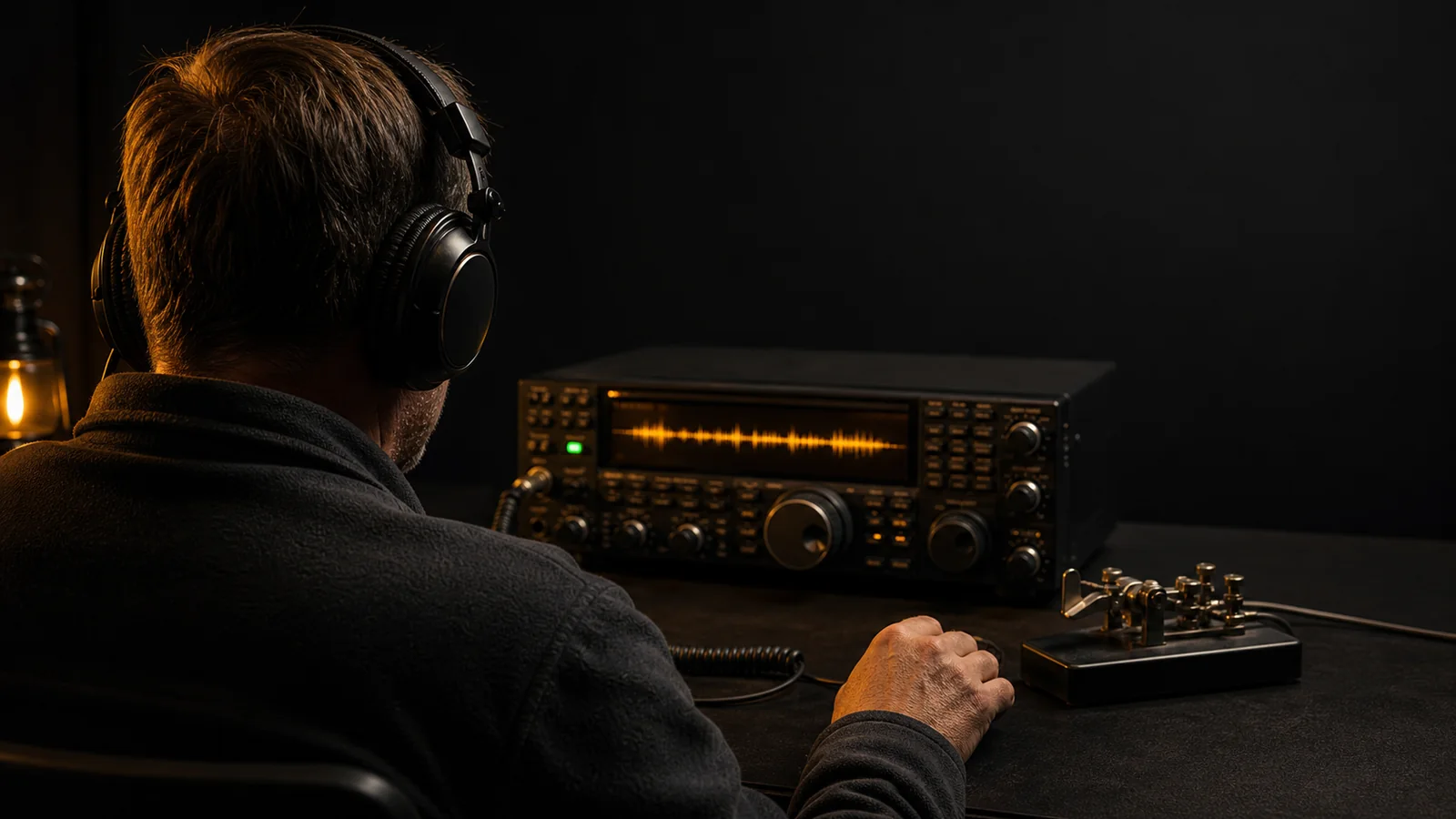
Learning the Morse chart is not the same as copying CW. A chart teaches that C is -.-., but an operator on the air does not have time to translate four separate elements into a letter. The useful skill is hearing the complete rhythm of C and recognizing it immediately.
That change, from visual translation to audio recognition, is the foundation of reliable CW copy. This guide explains how to make it without turning every practice session into a speed test.
Why counting dots and dashes becomes a dead end
At very low speed, it is tempting to count: dah, dit, dah, dit, then search a mental chart. The method feels safe because it produces an answer, but it builds a long chain:
- Hear individual elements.
- Count and remember their order.
- Convert the pattern into a visual symbol.
- Search for the matching character.
- Write the character.
Real CW keeps arriving while that chain is running. One delayed character can make the next character late, and soon the whole word is lost.
CW Academy's beginner curriculum describes Morse code as an audio language and tells students to learn the complete sound pattern rather than the individual dits and dahs. This is also why faster character speed with wider spacing is often more useful than making every element extremely slow.
Hear one character as one sound
Think about a short spoken word. You normally recognize its shape without naming every phoneme. Morse characters can be learned in the same way.
For example:
Eis a very short sound.Tis one long sound.Ahas a rising short-long rhythm.Nhas a falling long-short rhythm.Chas a balanced long-short-long-short rhythm.
The labels above are only orientation. During practice, do not say "dit" or "dah" in your head. Let the sound trigger the character.
This is commonly called instant character recognition. It does not mean zero mistakes. It means the answer appears quickly enough that you can stay with the stream.
Use character speed and effective speed separately
Farnsworth timing keeps each character reasonably brisk while adding more silence between characters and words. The extra time gives your brain space to recognize and write the answer without stretching the character itself into a countable sequence.
A practical starting range is:
| Setting | Starting point | What it controls |
|---|---|---|
| Character speed | 18 to 25 WPM | The rhythm inside each character |
| Effective speed | 5 to 10 WPM | The overall pace after extra spacing |
| Tone | 500 to 750 Hz | Listening comfort, not difficulty |
| Session length | 5 to 15 minutes | Focus before fatigue appears |
These are training ranges, not rules. If 25 WPM characters sound like an indistinct blur, step down slightly. If you can count every element comfortably, increase the character speed. Keep the effective speed slow enough that you can recover after a miss.
A five-stage copy routine
1. Learn a small character set
Start with two to four characters whose sounds are clearly different. A useful first group is E, T, A, and N. Play random sequences and type or write only the character you hear.
Do not repeat the sound mentally after it has passed. Make the best decision you can and prepare for the next character.
2. Add characters by sound, not alphabet order
Alphabet order has no special value in audio learning. Add a few characters at a time and mix new sounds with familiar ones. If two characters are repeatedly confused, isolate that pair for one short drill, then return them to a larger group.
3. Move from characters to useful chunks
Random characters build recognition, but operators also benefit from common sound groups:
CQDERSTQTHNAME73K,KN, andSK
These become audio landmarks in a contact. When you hear RST, you already know that a report is likely to follow.
4. Copy real callsigns
Callsigns are excellent intermediate material. They combine letters and numbers, have recognizable prefix structures, and force you to copy exactly rather than guess from ordinary language.
Use the CW599 Callsign Trainer for short rounds. Set a comfortable WPM, hide the answer, listen once, and enter what you heard. A five-minute session with full attention is more valuable than thirty minutes of distracted repetition.
5. Practice the structure of a QSO
Once characters and callsigns are stable, move into predictable exchanges. The CW599 QSO Simulator lets you rehearse CQ, callsigns, RST, name, QTH, and 73 in sequence.
Predictability is useful here. It reduces the number of unknowns while you learn to copy behind, recover after a missed character, and recognize operating patterns.
What to do when you miss a character
The most damaging habit is freezing. A missed character is already gone. If you replay it in your head, you will often miss two more.
Use this recovery method:
- Mark the unknown with a short dash, a space, or
?. - Keep listening immediately.
- Use the rest of the word or exchange for context.
- Review the missed character after the exercise.
On paper, leave enough space to add a character later. On a keyboard, resist the urge to backspace during live copy.
Short practice beats one long weekly session
CW recognition depends on fast recall. Frequent short exposure strengthens that recall while fatigue does the opposite.
A simple weekly pattern is:
| Day | Main exercise | Time |
|---|---|---|
| Monday | Character groups | 10 minutes |
| Tuesday | Callsigns | 10 minutes |
| Wednesday | Common CW words and abbreviations | 10 minutes |
| Thursday | QSO exchange | 15 minutes |
| Friday | Difficult character pairs | 8 minutes |
| Weekend | Relaxed listening or an on-air contact | 15 to 30 minutes |
Keep a small log with the date, settings, score, and two difficult characters. The purpose is not to collect perfect scores. It is to notice what should be practiced next.
Common mistakes that slow progress
Watching the answer while listening
Reading and hearing at the same time can create visual recognition instead of audio recognition. Hide the text until after you respond.
Practicing only familiar material
Repeating one memorized phrase can sound fluent without improving general copy. Mix callsigns, numbers, abbreviations, and short phrases.
Increasing speed after one good score
Look for consistency across several sessions. A temporary high score may come from lucky material or guessing.
Treating every miss as failure
Training near the edge of your ability should produce some errors. The useful question is whether recognition is becoming faster and recovery is becoming easier.
Copying every word on paper forever
Writing is valuable, especially for callsigns, numbers, and traffic. As recognition improves, occasionally listen without writing and try to retain one short phrase. This begins the transition toward head copy.
A practical two-week plan
For the first week, spend most of the time on characters and callsigns. Keep character speed high enough that counting is uncomfortable, but use generous spacing.
During the second week, keep one short character drill and add structured QSO material. Copy only the essential information: callsign, RST, name, QTH, and closing. This is closer to how many real contacts are logged.
At the end of two weeks, compare your first and latest sessions. Improvement may appear as fewer long pauses, cleaner recovery, or better callsign accuracy before it appears as a higher WPM number.
The goal is readable communication
CW is not a race. Speed is useful only when recognition remains dependable and the operator can stay calm after a mistake. Train complete sounds, leave enough spacing to think, and increase effective speed gradually.
When you are ready, open the Callsign Trainer for a five-minute round, then try one exchange in the QSO Simulator. The route from chart knowledge to real CW is built one recognized sound at a time.