
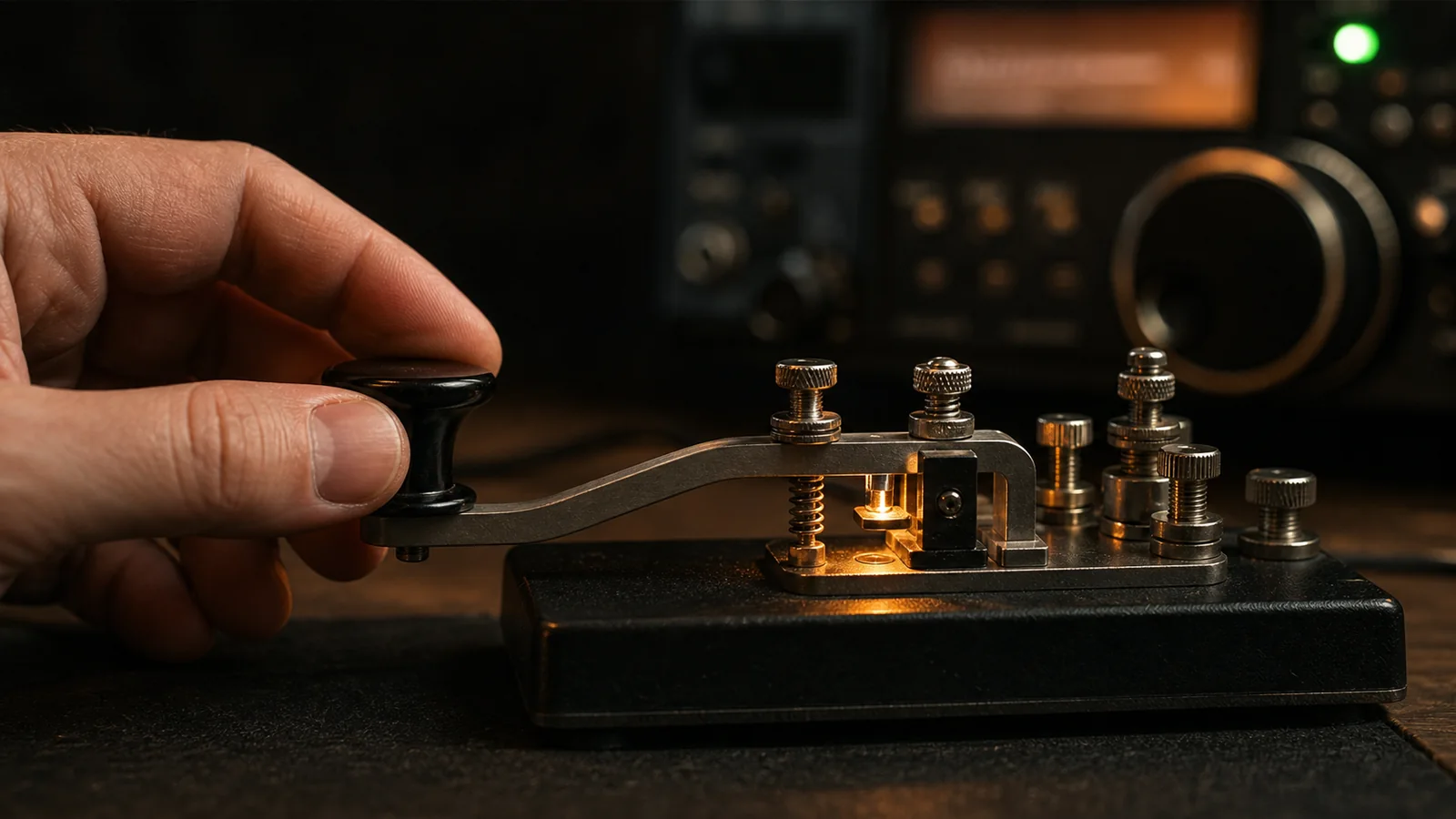
A straight key gives the operator direct control over every dit, dah, and gap. That simplicity is part of its appeal, but it also means that the rhythm comes from the hand rather than an electronic keyer.
Readable straight-key CW is not created by hitting the contact harder or moving faster. It comes from consistent proportions, clear spacing, relaxed movement, and careful listening.
The standard Morse timing units
International Morse timing is built from one basic unit:
| Part of the signal | Length |
|---|---|
| Dit | 1 unit |
| Dah | 3 units |
| Gap between elements of one character | 1 unit |
| Gap between characters | 3 units |
| Gap between words | 7 units |
The ITU-R M.1677-1 recommendation is the international reference for Morse signals and their spacing.
For the letter A (.-), the timing is:
1 unit ON
1 unit OFF
3 units ON
The three-unit character gap begins after the dah. Do not add an extra one-unit element gap after the final element; the complete silence between characters is three units.
Converting WPM into milliseconds
Standard Morse speed is conventionally based on the word PARIS, which occupies 50 timing units. A useful approximation for the duration of one dit is:
dit duration in milliseconds = 1200 / WPMExamples:
| Speed | Dit | Dah | Character gap | Word gap |
|---|---|---|---|---|
| 10 WPM | 120 ms | 360 ms | 360 ms | 840 ms |
| 15 WPM | 80 ms | 240 ms | 240 ms | 560 ms |
| 20 WPM | 60 ms | 180 ms | 180 ms | 420 ms |
You do not need to count milliseconds while sending. The table is useful for calibrating a trainer, analyzing a recording, or understanding why a slightly long dit can turn into a short dah at higher speed.
What makes straight-key CW difficult to copy
Dahs that are too short
If a dah is only twice as long as a dit, characters such as A, N, U, and D become less distinct. Aim for an audible 1:3 relationship, not a tiny difference.
Dits that grow under tension
When the hand becomes tense, dits often lengthen. This makes H sound like an uneven series and can blur the difference between a dit and a dah.
Missing character spaces
Even perfectly formed elements become unreadable when characters run together. Many sending problems that sound like incorrect letters are actually spacing problems.
Excessive word gaps
Very long pauses inside a sentence can make the other operator think the transmission is finished. Word gaps should be clearly longer than character gaps without breaking the flow.
Correcting inside a malformed character
Once a character has gone wrong, trying to repair it mid-pattern usually creates an unknown sequence. Stop, leave a clear gap, send the error prosign if appropriate, and repeat the word.
Adjust the key before practicing
A straight key should not force the hand to fight the mechanism.
Contact gap
Start with a small but definite contact gap. Too wide a gap requires excessive travel and encourages pounding. Too narrow a gap may cause accidental contact or a sticky feel.
There is no universal measurement because keys, bearings, springs, and operator preference differ. Make small adjustments and test them with the key connected to a sidetone oscillator or transceiver in practice mode.
Spring tension
Use enough return force for the contact to open reliably. Excessive tension causes fatigue and makes short elements harder to control. Very light tension can feel vague and may lead to unintended closures.
Knob height and arm position
Place the forearm comfortably on the desk with the wrist close to neutral. The movement should come from a relaxed forearm and wrist combination, not from lifting the entire shoulder or pinching with the fingertips.
Some skilled operators use different techniques. The important test is whether the motion remains relaxed and repeatable for an entire contact.
Listen to the sidetone, not the hand
Mechanical movement is only an indirect signal. The other operator hears the transmitted rhythm.
Use a sidetone that is comfortable, commonly somewhere around 500 to 750 Hz. Close your eyes for part of the exercise and listen for:
- Consistent dit length
- Consistent dah length
- A clear difference between dit and dah
- Equal element spacing inside a character
- Stable character and word gaps
Record one minute of sending and copy it later as if it came from another station. CW Academy also recommends recording and playing back sending as a way to assess rhythm in its beginner curriculum.
Five practical straight-key drills
1. Alternating elements
Send:
E T E T E TListen for a stable 1:3 length ratio. Leave a full character gap between each letter.
2. Repeated simple characters
Send:
EEEEE TTTTT AAAAA NNNNNThe goal is not maximum speed. Every repetition should sound like the same character.
3. Balanced pairs
Send:
AN AN AN RN RN RN SK SK SKThese combinations expose element and character spacing. If the letters merge, increase the character gap without slowing the elements.
4. The word PARIS
Send PARIS repeatedly at a comfortable pace. It contains a useful mixture of element patterns and is also the reference word used for standard WPM timing.
Leave a seven-unit word gap before repeating it:
PARIS PARIS PARIS5. A real QSO line
Send:
CQ CQ DE BA7MTH K
UR RST 579 NAME JOHN
TNX QSO 73 SK
Operational phrases reveal whether rhythm remains stable when attention shifts from element formation to meaning.
Use spacing to slow down
When another operator asks QRS, avoid stretching every element far beyond its normal ratio. Send recognizable characters at a comfortable character speed, then add more space between characters and words.
This is similar in principle to Farnsworth timing. The character retains its sound identity while the overall exchange becomes easier to copy.
For example, a character may still sound close to 15 WPM while the wider spacing makes the effective message rate closer to 8 or 10 WPM.
Build speed only after rhythm is stable
Increase speed in small steps. A useful progression is:
- Send a one-minute drill at a relaxed speed.
- Record and listen back.
- Identify one problem, such as short dahs or narrow letter gaps.
- Repeat the drill while correcting only that problem.
- Increase by 1 or 2 WPM after several clean sessions.
Trying to fix speed, grip, dah length, and spacing all at once makes it difficult to know what improved.
Fatigue changes timing
Straight-key sending is physical. As the forearm tires, the hand may press harder, dits may lengthen, and spacing may collapse.
Stop a focused drill after 5 to 10 minutes, loosen the hand, and rest. During a longer QSO, reduce speed before timing deteriorates. Pain, numbness, or persistent strain is not a normal training requirement.
Measure without becoming mechanical
Timing analysis can identify patterns that the ear misses, but the final goal is natural, readable communication. A waveform can show that your average dah is 2.6 units, yet only listening reveals whether the complete message has an easy rhythm.
Use numbers for diagnosis, then return to the sidetone. The best straight-key sending has consistent proportions without sounding lifeless.
A clean rhythm is your signature
Every straight-key operator has a small personal character, but individuality should sit on top of readable timing. Keep dits short, dahs clearly longer, spaces deliberate, and motion relaxed.
Practice slowly enough to control the rhythm, then let speed grow from consistency. A well-sent 12 WPM signal will usually be copied with more pleasure than an uneven 20 WPM signal.