Turn on an HF transceiver, switch the mode to CW, and start tuning the VFO.
Then comes a simple question:
Where should you tune?
For operators who are just beginning to make real CW contacts, this is an easy question to overlook.
We know that the 20-meter amateur band is around 14 MHz and 40 meters is around 7 MHz, but each amateur band can be tens or even hundreds of kilohertz wide. If you simply scan the entire band at random, you may spend a long time tuning without hearing much CW activity.
After decades of amateur radio operation, however, fairly stable CW operating habits have developed around the world.
Some parts of a band are where you are more likely to hear ordinary CW QSOs. Some frequencies are recognized as activity centers for low-power QRP operators. Others are commonly associated with slower-speed QRS activity.
Understanding these patterns is far more useful than simply memorizing that “7 MHz is the 40-meter band.”
First: There Is No Single Worldwide “CW Calling Frequency”
This is important.
Amateur radio CW does not work like maritime VHF, where there is a globally recognized calling and distress channel such as Channel 16.
CW activity normally occupies a range of frequencies, rather than a single channel where everyone gathers.
The International Amateur Radio Union, or IARU, divides the world into three major regions:
- Region 1: mainly Europe, Africa, the Middle East, and parts of Russia;
- Region 2: mainly North America, South America, and the Caribbean;
- Region 3: mainly China, Japan, Korea, India, Southeast Asia, Australia, New Zealand, and the Pacific.
The band plans in these three regions are broadly similar, but they are not identical.
For example, the current IARU Region 3 Band Plan identifies 7000–7030 kHz as a CW segment on 40 meters, while 7030 kHz is also listed as a QRP Centre of Activity.
Region 1 and Region 2 arrange parts of 40 meters somewhat differently, and operators in the United States are also subject to FCC license-class privileges and frequency limits. ARRL also emphasizes that a band plan is primarily a voluntary coordination tool and is not the same thing as legal frequency authorization.
So the better question is:
“Which frequencies are the best places to look for CW operators?”
A Quick Reference to Major CW Frequencies
The following table is intended as a practical operating reference.
| Band | Common CW Activity Area | Frequencies Worth Remembering | Typical Use |
|---|---|---|---|
| 160 m | Around 1.800–1.840 MHz | 1.836 MHz | QRP / CW activity center |
| 80 m | Around 3.500–3.600 MHz | 3.560 MHz | CW QRP |
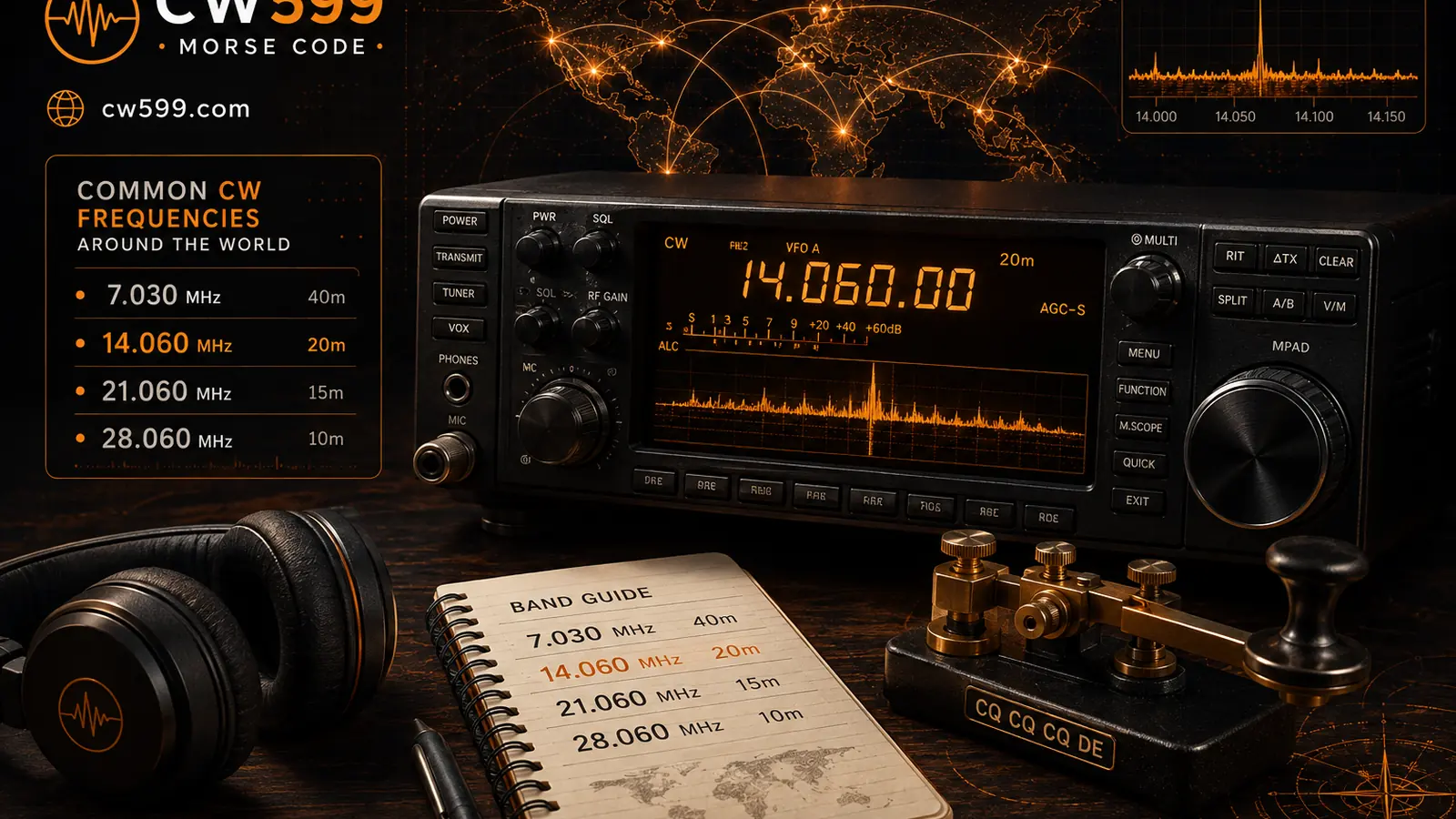
| 40 m | Around 7.000–7.040 MHz | 7.030 MHz | Major worldwide CW QRP activity center |
| 30 m | Around 10.100–10.130 MHz | 10.116 MHz | CW QRP |
| 20 m | 14.000–14.070 MHz | 14.055 / 14.060 MHz | QRS / QRP |
| 17 m | 18.068–18.095 MHz | 18.086 MHz | CW QRP |
| 15 m | 21.000–21.070 MHz | 21.055 / 21.060 MHz | QRS / QRP |
| 12 m | 24.890–24.915 MHz | 24.906 MHz | CW QRP |
| 10 m | 28.000–28.070 MHz | 28.055 / 28.060 MHz | QRS / common CW QRP activity |
An “activity center” does not mean that every contact must take place on exactly that frequency.
For example:
14.060 MHz is a QRP Centre of Activity.
What that really means is:
“If you are operating low-power CW, or you want to find QRP stations, this is a good place to start listening.”
It does not mean:
“All CW QSOs should take place on 14.060 MHz.”
Those are two very different ideas.
160 Meters: 1.8 MHz — The Nighttime CW World
160 meters is often called the Top Band.
It depends heavily on nighttime propagation, and the antennas required can be physically large. For that reason, it is not as easy to enter as 40 or 20 meters.
But for operators who enjoy low-band DX, 160 meters has a unique appeal.
In the current IARU Region 3 Band Plan:
- 1800–1830 kHz: CW
- 1830–1840 kHz: CW + narrowband
and:
1836 kHz
is listed as a QRP Centre of Activity.
This band also demonstrates why worldwide frequency habits are not always identical.
For example, the ARRL Band Plan in the United States identifies:
1810 kHz
for CW QRP activity.
So on 160 meters, it is not safe to assume that every part of the world uses exactly the same QRP activity center.
For intercontinental DX, the best practice is to check the band plans and regulations that apply to both ends of the contact.
80 Meters: 3.5 MHz — A Very Active Nighttime CW Band
80 meters is another classic nighttime band.
It is especially useful for regional communication.
During the evening in Asia, Europe, or North America, it is common to hear significant CW activity near the lower end of the band.
The current IARU Region 3 plan includes:
- 3500–3510 kHz: CW, DX
- 3510–3535 kHz: CW
Above that, CW increasingly shares spectrum with other narrowband modes and, later, voice operation.
One frequency worth remembering is:
3560 kHz
which is listed as a CW QRP Centre of Activity.
So if you turn on 80 meters at night and do not know where to begin, start near:
3.500 MHz
and slowly tune upward.
If you are specifically looking for QRP stations, listen around:
3.560 MHz.
40 Meters: 7 MHz — Perhaps the Most Useful CW Band to Remember
If someone could choose only one band to begin practical CW operation, 40 meters would be one of the strongest candidates.
The reasons are simple:
- it works during the day;
- it also works at night;
- regional coverage is excellent;
- DX is possible when conditions cooperate;
- worldwide CW activity is very high.
The current IARU Region 3 Band Plan identifies:
7000–7030 kHz
as CW.
The next segment:
7030–7040 kHz
allows CW together with other narrowband operation.
And:
7030 kHz
is designated as a QRP Centre of Activity.
This is a frequency worth remembering.
IARU Region 3 discussions of 40-meter planning have also described 7030 kHz as an important core CW frequency and a major worldwide QRP activity center.
For that reason:
7.030 MHz is probably one of the most useful CW numbers for a beginner to remember.
But that does not mean you should sit exactly on 7030 and call CQ continuously.
A better operating habit is:
- listen around 7030 for activity;
- move slightly up or down if the frequency is busy;
- find a clear spot;
- send
QRL?to check whether the frequency is in use; - then begin calling CQ.
30 Meters: 10 MHz — A Band Made for CW
30 meters is a special band.
It is one of the WARC bands and is not normally used for the major traditional contests that can fill 20 and 40 meters.
That often makes it relatively quiet.
For operators who simply enjoy normal QSOs, DX, QRP, and unhurried CW, that is a major advantage.
IARU Region 3 recommends CW activity in:
10110–10130 kHz
with:
10116 kHz
listed as a CW QRP Centre of Activity.
There are some regional differences near the bottom of the 10 MHz allocation, so in practical operation it is useful to think of:
10.100–10.130 MHz
as a general CW-rich area worth scanning, while still following your local rules.
Another major feature of 30 meters is that in many countries the band is used mainly for CW and narrowband digital modes rather than ordinary voice communication.
From a CW operator's point of view, 30 meters can therefore feel like one of the purest HF bands.
20 Meters: 14 MHz — The Classic Global CW DX Band
If 40 meters is the practical all-rounder, then:
20 meters is the classic worldwide DX band.
Propagation around 14 MHz is extremely useful for intercontinental communication.
Open 20 meters during the daytime and you may hear callsigns from:
JA, VK, W, K, VE, DL, F, G, I, EA…
along with all kinds of DXCC prefixes.
IARU Region 3 identifies:
14.000–14.070 MHz
as the principal CW segment.
Two frequencies are especially useful to remember.
14.055 MHz — QRS Centre of Activity
In CW, QRS means:
Send more slowly.
For that reason, the area around 14.055 MHz can be a good place to find slower-speed CW activity.
The second frequency is even more famous:
14.060 MHz — CW QRP Centre of Activity
This is one of the best-known frequencies among QRP CW operators worldwide.
The IARU Region 1 band planning tradition also recognizes:
14.060 MHz
as a CW QRP activity center.
So if one day you take a 5-watt QRP radio and a portable antenna to a mountaintop:
listen around 14.060 MHz first.
It is rarely a bad place to start.
17 Meters: 18 MHz — An Underrated DX Band
17 meters is another WARC band.
It is usually less crowded than 20 meters and is not filled by traditional major contests.
IARU Region 3 identifies:
18.068–18.095 MHz
as the main CW segment.
Within that range:
18.086 MHz
is a CW QRP Centre of Activity.
17 meters is an interesting compromise.
When propagation is good, it offers some of the long-distance capabilities of 20 meters while usually having less atmospheric noise than the lower HF bands.
For operators who enjoy relatively quiet CW DX, it is well worth checking regularly.
15 Meters: 21 MHz — A Band That Suddenly Comes Alive
15 meters depends strongly on ionospheric conditions.
When propagation is poor:
the band may sound completely empty.
But when it opens:
CW stations thousands or even tens of thousands of kilometers away can suddenly appear one after another.
The IARU Region 3 CW plan is straightforward:
21.000–21.070 MHz: CW
with:
21.055 MHz — QRS Centre of Activity
and:
21.060 MHz — QRP Centre of Activity
These are easy to remember because they resemble the 20-meter pattern.
20 meters:
- 14.055 QRS
- 14.060 QRP
15 meters:
- 21.055 QRS
- 21.060 QRP
So a beginner does not actually need to memorize a huge number of frequencies.
12 Meters: 24 MHz — Another Quiet WARC CW Band
Like 17 and 30 meters, 12 meters is a WARC band.
Large traditional contests generally do not take over the band.
The main CW segment is:
24.890–24.915 MHz
and:
24.906 MHz
is a CW QRP Centre of Activity.
12 meters does not open every day.
But during strong solar conditions, it can support excellent long-distance propagation.
Experienced CW operators therefore do not always stay on 20 meters.
Checking 17, 15, 12, or even 10 meters from time to time can produce unexpected DX.
10 Meters: 28 MHz — One of the Most Magical Bands When It Opens
10 meters can be an extreme band.
When it is closed:
you may hear almost nothing.
When it opens:
5 watts, or even less, can sometimes work across continents.
The current IARU Region 3 plan identifies:
28.000–28.070 MHz
as a CW segment and designates:
28.055 MHz
as a QRS Centre of Activity.
In IARU Region 1 planning, another long-established frequency is:
28.060 MHz
as a CW QRP Centre of Activity.
So in real-world international CW operation:
28.055–28.060 MHz
is an especially useful area to scan.
It is worth noting that the latest Region 3 and Region 1 plans do not label every 10-meter activity center in exactly the same way. This is another reason to follow the band plan and regulations that apply where you are operating.
Where Are Ordinary CW Stations Actually Located?
There is another common misunderstanding.
Seeing:
14.060 = QRP
does not mean that ordinary 20-meter CW stations all operate on 14.060.
In real operation, you may hear CW QSOs on frequencies such as:
14.003, 14.012, 14.021, 14.028, 14.033, 14.041, 14.052…
Stations can be spread throughout the CW portion of the band.
During major CW contests such as CQ WW CW, ARRL DX CW, or CQ WPX CW, activity can become extremely dense across nearly the entire usable CW segment.
A better way to remember the spectrum is therefore:
Remember the CW segment first, then remember a few important activity centers.
For example:
20 meters → 14.000–14.070 MHz
Then remember:
- 14.055 QRS
- 14.060 QRP
That is usually enough.
Why Is CW Usually Near the Bottom of an Amateur Band?
Look at almost every HF amateur band and you will notice an interesting pattern:
CW tends to occupy the lower-frequency end.
For example:
- 40 m: CW begins near 7.000 MHz
- 20 m: CW begins near 14.000 MHz
- 15 m: CW begins near 21.000 MHz
- 10 m: CW begins near 28.000 MHz
This is not an accident.
CW uses very little bandwidth.
A typical CW signal may occupy only a few hundred hertz, while an SSB signal commonly requires roughly 2.4–2.7 kHz.
Placing large numbers of narrow CW signals near the bottom of an amateur band is therefore an efficient way to organize spectrum.
In the current IARU Region 3 Band Plan, CW-priority segments commonly use a recommended maximum bandwidth of around 200 Hz, while wider voice segments may allow around 2700 Hz.
What Does “QRP Centre of Activity” Really Mean?
Consider:
7030 kHz — QRP CoA
CoA means:
Centre of Activity.
It does not mean:
a channel.
It does not mean:
an exclusive frequency.
And it does not mean:
“only QRP stations may operate here.”
It is better understood as:
“This area is commonly used by a particular type of operation, so give those stations reasonable consideration.”
If you hear a very weak S1 CW signal near 7030, do not immediately transmit over it with a CQ call.
It might be a station running:
5 watts, 2 watts, 500 milliwatts, or even only a few tens of milliwatts,
trying to complete a contact over thousands of kilometers.
QRS Frequencies Are Especially Useful for New CW Operators
CW also has a valuable tradition:
QRS
which means:
Send more slowly.
Some bands have recognized QRS activity centers.
Examples include:
- 14.055 MHz
- 21.055 MHz
- 28.055 MHz
These areas are particularly worth monitoring if you are just starting to make real CW contacts.
If you can comfortably copy only:
8 WPM, 10 WPM, or 12 WPM,
there is no reason to think you are “not ready.”
Look for operators at similar speeds around QRS activity areas.
CW is not a speed contest.
A QSO in which both operators copy each other correctly is more valuable than forcing the speed to 30 WPM before you are ready.
Why Do the Three IARU Regions Differ?
Because radio regulations are ultimately written by individual countries.
The 40-meter band is a good example.
The exact amateur allocation is not identical worldwide.
The United States has a 40-meter amateur allocation extending to 7.300 MHz, while in many Region 1 and Region 3 countries the amateur allocation normally ends at 7.200 MHz.
License classes can also restrict which parts of a band an operator may use.
The key principle is therefore:
The IARU Band Plan is an important guide to international operating practice, but national regulations always come first.
IARU Region 3 likewise makes it clear that where a regional band plan conflicts with national rules, the national regulations take precedence.
If I Am a CW Beginner, Which Frequencies Should I Remember First?
You do not need to memorize the entire table.
A few frequencies are enough to begin.
7.030 MHz
Classic 40-meter QRP CW activity.
14.055 MHz
20-meter QRS activity, useful for slower CW.
14.060 MHz
One of the best-known QRP CW activity frequencies in the world.
21.060 MHz
15-meter QRP CW.
28.060 MHz
A useful place to look for 10-meter QRP CW when propagation is open.
And remember one rule that is even more useful than any single frequency:
On most HF amateur bands, the lower-frequency end is the first place to look for CW.
The Operating Habit That Matters More Than Memorizing Frequencies
Knowing the frequencies is only the first step.
When you actually operate CW, the more important habit is:
Listen first.
Listen again.
Transmit last.
Do not tune to exactly 7.030.000 just because “7030 is the QRP frequency” and immediately start calling CQ.
CW signals are narrow.
There could be separate QSOs at 7.0295, 7.0300, and 7.0307 at the same time.
After finding what appears to be a clear frequency, send:
QRL?
Then listen.
If there is no answer, ask once more.
When you are reasonably sure the frequency is clear, begin:
CQ CQ CQ DE XXXXX XXXXX K
This operating etiquette developed decades ago, and it remains valuable today.
Before a first on-air QSO, rehearse the sequence with the CW599 QSO Simulator. Use the CW599 Morse Translator to check a practice message or review common operating text.
A Practical CW Memory Table
Here is the entire guide reduced to a simple reference:
| Band | Main CW Area | Useful CW Activity Centers |
|---|---|---|
| 160 m | 1.800–1.840 | 1.836 |
| 80 m | 3.500–3.600 | 3.560 |
| 40 m | 7.000–7.040 | 7.030 |
| 30 m | 10.100–10.130 | 10.116 |
| 20 m | 14.000–14.070 | 14.055 QRS / 14.060 QRP |
| 17 m | 18.068–18.095 | 18.086 |
| 15 m | 21.000–21.070 | 21.055 QRS / 21.060 QRP |
| 12 m | 24.890–24.915 | 24.906 |
| 10 m | 28.000–28.070 | 28.055 QRS / 28.060 common CW QRP |
All frequencies are in MHz.
This table is not a legal transmitter authorization chart.
It is better understood as:
A map showing where to look for CW.
That is what makes it useful.
Conclusion: CW Frequencies Are a Quiet Kind of Agreement
One of the most interesting things about amateur radio is that operators around the world may speak different languages, come from different cultures, and operate under different national regulations.
But when the VFO reaches:
7.030
or:
14.060
many CW operators immediately understand what those numbers suggest.
A small radio running only a few watts.
A temporary portable antenna.
Someone listening for a distant signal.
Over time, these frequencies have become part of CW culture itself.
And that is one of the reasons Morse code remains so fascinating today.
When Everything Fails, CW Still Works.
Sources and Important Notes
This article is based primarily on IARU Region 1, Region 2, and Region 3 band-planning information, together with the ARRL Band Plan.
Please keep the following in mind:
- IARU band plans are primarily coordination guides and are not the same thing as national law;
- before transmitting, always check the latest regulations for your country or territory;
- confirm your license privileges, permitted frequency ranges, and power limits;
- regional band plans can change over time;
- the frequencies in this article are best treated as a practical guide to finding CW activity, not as a legal authorization to transmit.
References
- IARU Region 1 Band Plans
Band Plans
- IARU Region 3 Band Plan
https://www.iaru-r3.org/wp-content/uploads/2025/01/R3-004-Band-Plans-IARU-Region-3.pdf
- ARRL Band Plan
https://www.arrl.org/band-plan
- ARRL Frequency Allocations
https://www.arrl.org/frequency-bands
CW599 — When Everything Fails, CW Still Works.