Connect and select
Select CW and set front/rear key jack behavior.
Use the dedicated keying and pitch controls to establish a repeatable CW setup. Japan resumed TS-990S orders in September 2025, while the European product page marks it discontinued. Availability is regional; this guide uses the English operating manual rather than assuming every current unit has the same firmware.
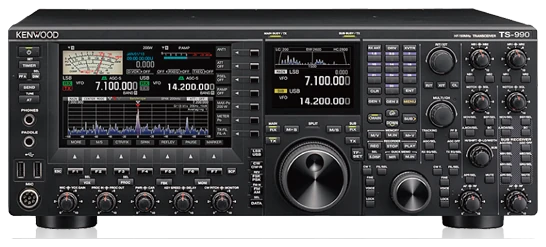
English TS-990S instruction manual B62-2389-10, edition 1.01, from Kenwood US support; CW operations and dual-band controls. Regional options and firmware revisions may differ. Checked 2026-10-07; original firmware; printed manual pages unless marked PDF.
Use this order as an operating checklist, not as a replacement for the radio manual. Controls and available options can vary by firmware and region.
Select CW and set front/rear key jack behavior.
Disable break-in and SEND; verify side tone with no RF.
Adjust key speed, pitch and menu 1-02 side-tone volume.
Tune one wanted note and verify the receiver/transmit side.
Enable semi break-in, send one short call and listen before repeating.
Search by setting or menu path. Manufacturer defaults and recommendations are labeled separately from CW599 advice; references identify the checked manual or software version.
RX (S); TX (M) / TX (S); TF-SETCW599 note: RX (S) enables the second receiver; it does not by itself choose your transmit band. With reception on main, TX (S) selects sub-band transmit and lights SPLIT. Check both frequencies before keying; hold TF-SET to listen at the transmit frequency, then release it. TX (M) returns this setup to simplex.
MENU > 5-00 / 5-01CW599 note: Set the actual socket used; front and rear defaults differ. Test with break-in disabled. An external electronic keyer normally needs direct Straight Key input, not another automatic keyer stage.
KEY SPEEDCW599 note: Turn the dedicated speed control while practicing a short callsign. Read the temporary speed display and keep your outgoing speed close to a caller you can comfortably copy.
CW PITCH; MENU > 1-02CW599 note: Choose a comfortable note, then use menu 1-02 for a fixed side-tone level or leave it linked to MONITOR. AF does not set sidetone/message playback volume. Check with a short no-RF practice after changing headphones.
VOX/SEL; DELAY; FBKCW599 note: Use VOX/SEL for semi break-in and DELAY for recovery time; FBK selects full break-in. Confirm the corresponding LED and return to reception after a short test. The two modes are mutually exclusive. CW599: start with semi until amplifier switching is confirmed.
CW; break-in and SEND offCW599 note: Disable all transmit-enabling actions before practicing. Confirm no RF output while testing the key and memories; leave SEND untouched until the station is ready for an on-air check.
MENU > 5-14 > CW Rise TimeCW599 note: Keep the documented value for initial setup. Evaluate any faster edge with the actual station and a reliable transmitted-signal report, rather than judging only the local monitor.
MENU > 5-10 > CW Message Entry; F2 KEYERCW599 note: Select CW on the transmit band and close the bandscope with SCP if KEYER is hidden. Choose the entry method, hold a channel to edit, and save a short call. Test with VOX and FBK indicators off and SEND off; F5 STOP ends playback. Recheck the serial after rehearsal.
MENU > 5-11 / 5-13; KEYERCW599 note: Set the starting serial in 5-11 and the count-up channel in 5-13. That channel increments the number after playback or transmission ends. Compare with your log after rehearsal or a failed exchange. In text-entry mode with count-up enabled, KEYER F6 [-1] lets you correct one unwanted increment.
No matching settings. Try a shorter search or clear the search and category.
These are original operator-oriented starting points. They are not factory presets and intentionally avoid claiming model-specific default values.
Check one change at a time.
Keep the wanted signal audible.
Leave a clear path back to receiving.
The checked documentation does not provide a built-in received-CW text workflow for TS-990S. The checked manual’s DECODE screen covers FSK/PSK. Do not transfer TS-890S CW-decoder menus to this radio.
Use menu 1-02 Sidetone Volume. Side tone and CW message playback are separate from receiver AF level.
No. Break-in controls and menu numbers differ. Use this model’s paths, especially CW Rise Time and CW Message Entry.
Use the manufacturer-controlled product and support pages to verify your region, firmware, menus, connector wiring, operating limits, and safety information. CW599 does not host, mirror, or reproduce the manual.
Search and filters run locally in your browser and do not connect to a radio. Version 1.0 (2026-10-07): four-language guide and sourced product photo. Revisions are retained in site Git and release backups; no separate archived page.